
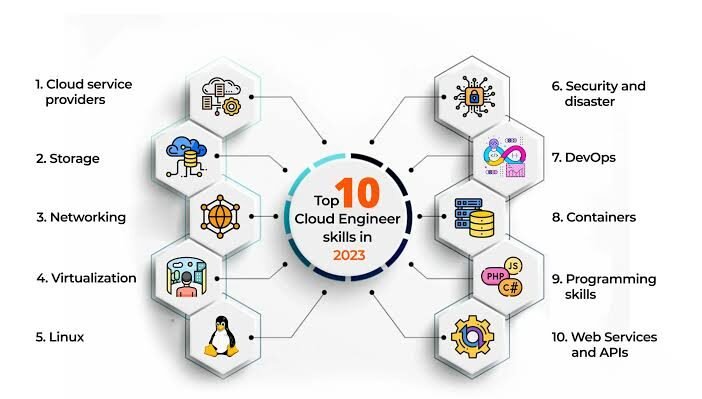
Cloud computing has become a major part of modern technology. Businesses use cloud platforms to host applications, store data, manage infrastructure, build artificial intelligence solutions, and support digital services.
As cloud adoption continues to grow, organizations need professionals who can design, deploy, secure, automate, and manage cloud environments.
This has created exciting opportunities for people interested in technology.
However, starting a career in cloud computing requires more than knowing how to create a virtual machine or use a cloud console. Successful cloud professionals combine technical knowledge with problem-solving, security awareness, communication, automation, and business understanding.
If you’re planning to become a cloud engineer, cloud architect, DevOps engineer, cloud security specialist, or another cloud professional, understanding the most important skills can help you create a focused learning plan.
In this guide, we’ll explore the essential cloud computing skills you need to develop, why they matter, and how you can build them through practice and real-world projects.
What Skills Do You Need for a Cloud Computing Career?
Cloud computing is a broad field, so the exact skills required depend on the role.
A cloud engineer may focus heavily on infrastructure and automation, while a cloud security engineer may spend more time on identity, security monitoring, and compliance.
However, several foundational skills are useful across almost every cloud career.
These include:
- Cloud fundamentals
- Networking
- Linux
- Programming and scripting
- Cloud platforms
- Security
- Databases
- Containers
- Infrastructure as Code
- DevOps
- Monitoring
- Troubleshooting
- Communication
- Problem-solving
Let’s look at each skill in more detail.
1. Cloud Computing Fundamentals
The first skill every cloud professional needs is a strong understanding of cloud computing concepts.
You should understand how cloud infrastructure works and why organizations use it.
Important topics include:
- Public cloud
- Private cloud
- Hybrid cloud
- Multicloud
- IaaS
- PaaS
- SaaS
- Virtualization
- Scalability
- Elasticity
- High availability
- Fault tolerance
- Disaster recovery
- Regions
- Availability zones
You don’t need to memorize every cloud service.
Instead, focus on understanding the underlying concepts.
For example, you should understand why a business might deploy an application across multiple availability zones instead of relying on a single server.
Strong fundamentals make advanced cloud technologies much easier to understand.
2. Networking Skills
Networking is one of the most important skills for a cloud computing career.
Cloud infrastructure depends on networking.
Applications need to communicate with databases. Users need to connect to applications. Servers need to communicate securely with other systems.
You should understand:
- IP addresses
- Subnets
- DNS
- TCP/IP
- HTTP and HTTPS
- Ports
- Routing
- Firewalls
- VPNs
- Load balancing
- Network security
You don’t necessarily need advanced networking certifications to begin a cloud career.
However, you should be comfortable troubleshooting basic connectivity problems and understanding how cloud networks are structured.
3. Linux Skills
Linux is widely used in cloud infrastructure.
Many cloud servers run Linux-based operating systems, making Linux administration an important skill.
Cloud professionals should understand:
- Linux commands
- File systems
- Permissions
- Users and groups
- Processes
- Services
- Package management
- SSH
- Logs
- Environment variables
- Shell scripting
You should be able to connect to a remote Linux server, investigate problems, install software, manage permissions, and read system logs.
These skills are particularly valuable for cloud engineering and DevOps roles.
4. Programming and Scripting
You don’t have to be an expert software developer to work in cloud computing.
However, programming skills can significantly improve your productivity.
Python is a popular choice because it can be used for:
- Automation
- Cloud APIs
- Data processing
- Infrastructure tools
- Security scripts
- Artificial intelligence
Bash is also valuable for Linux automation.
Start with basic concepts such as variables, loops, functions, conditions, data structures, APIs, and error handling.
Your goal should be to automate repetitive tasks rather than manually performing everything.
5. Knowledge of a Major Cloud Platform
Cloud professionals should have practical experience with at least one major cloud provider.
The three major platforms are:
Amazon Web Services
Amazon Web Services provides a huge range of cloud services and is a popular choice for learning general cloud infrastructure.
Microsoft Azure
Microsoft Azure is particularly important in enterprise environments and organizations that rely heavily on Microsoft technologies.
Google Cloud
Google Cloud is especially attractive for professionals interested in data analytics, artificial intelligence, machine learning, and cloud-native development.
You don’t need to master all three immediately.
Start with one.
Learn its compute, storage, networking, database, identity, and monitoring services.
Once you understand one provider, learning another becomes much easier.
6. Cloud Security Skills
Security is no longer an optional skill for cloud professionals.
Cloud environments contain valuable information and business-critical applications.
You should understand:
- Identity and access management
- Authentication
- Authorization
- Multi-factor authentication
- Least privilege
- Encryption
- Network security
- Secrets management
- Logging
- Security monitoring
- Vulnerability management
One of the most important concepts is the shared responsibility model.
Cloud providers secure the infrastructure they operate, while customers remain responsible for many aspects of their own data, applications, identities, and configurations.
Understanding this division is essential for building secure cloud environments.
7. Database Knowledge
Cloud applications frequently depend on databases.
You don’t necessarily need to become a database administrator, but you should understand database fundamentals.
Learn the difference between:
- Relational databases
- NoSQL databases
- SQL
- Structured and unstructured data
- Transactions
- Indexes
- Replication
- Backups
You should also understand when a relational database might be a better choice than a NoSQL database.
This knowledge will help you design better cloud applications.
8. Containers and Docker
Containers have become an important part of modern cloud development.
Docker is a useful technology to learn because it teaches you how applications can be packaged with their dependencies.
Learn:
- Container images
- Containers
- Dockerfiles
- Container registries
- Volumes
- Container networking
After learning Docker, you can explore Kubernetes.
Kubernetes is widely used to orchestrate containerized applications.
Don’t rush into advanced Kubernetes concepts before understanding how containers work.
9. Infrastructure as Code
Modern cloud environments often need to be created and managed automatically.
Infrastructure as Code (IaC) allows engineers to define infrastructure using configuration files.
Terraform is one popular Infrastructure-as-Code tool.
With IaC, engineers can define:
- Networks
- Servers
- Databases
- Storage
- Security configurations
This approach can make infrastructure more repeatable and easier to manage.
It also allows teams to review infrastructure changes using version-control systems.
10. DevOps and CI/CD
Cloud computing and DevOps are closely connected.
DevOps focuses on improving collaboration between development and operations while automating software delivery and infrastructure management.
Cloud professionals should understand concepts such as:
- Version control
- Git
- Continuous Integration
- Continuous Deployment
- Automated testing
- Deployment pipelines
- Infrastructure automation
- Monitoring
You don’t need to become a DevOps expert immediately.
Start by building a simple pipeline that automatically tests and deploys an application.
11. Monitoring and Observability
Deploying an application is only the beginning.
Cloud professionals need to know whether applications are working correctly.
Monitoring helps teams understand system health and performance.
Important areas include:
- CPU utilization
- Memory usage
- Network traffic
- Disk usage
- Application errors
- Response times
- Availability
- Authentication events
Observability goes further by helping engineers understand why something is happening inside a system.
Learn how to work with logs, metrics, and traces.
12. Troubleshooting and Problem-Solving
Technical knowledge is valuable, but troubleshooting ability is one of the most important skills in a cloud career.
Cloud environments can fail for many reasons.
A website might stop responding because of:
- DNS problems
- Network configuration
- Application errors
- Database issues
- Incorrect permissions
- Resource exhaustion
- Security controls
Good cloud professionals don’t simply guess.
They investigate systematically.
A useful troubleshooting process is:
- Identify the problem.
- Gather evidence.
- Check recent changes.
- Narrow down possible causes.
- Test your assumptions.
- Fix the issue.
- Verify the solution.
- Document what happened.
The ability to stay calm and methodical during an incident can be extremely valuable.
13. Automation Skills
Cloud environments can contain thousands of resources.
Managing everything manually isn’t practical.
Automation can help with:
- Deployments
- Backups
- Infrastructure creation
- Security checks
- Monitoring
- Resource cleanup
- Scaling
Learn how to automate repetitive tasks using scripts, cloud-native tools, and Infrastructure as Code.
Automation not only saves time but can also reduce human error.
14. Cost Management
Cloud computing operates largely on usage-based pricing.
This means technical decisions can directly affect business costs.
Cloud professionals should understand basic cost-management principles.
For example, leaving unused servers running can create unnecessary expenses.
Learn how to:
- Monitor cloud spending
- Identify unused resources
- Choose appropriate instance sizes
- Use automated shutdown policies
- Understand storage costs
- Consider data-transfer costs
- Estimate workload expenses
You don’t need to become a financial expert.
But understanding how infrastructure decisions affect costs is an increasingly important cloud skill.
15. Communication Skills
Cloud careers are not purely technical.
Cloud professionals often work with developers, security teams, managers, business leaders, customers, and other departments.
You may need to explain technical concepts to people who don’t have an IT background.
Good communication helps you:
- Document systems
- Explain risks
- Discuss architecture
- Write technical reports
- Collaborate with teams
- Present solutions
Strong communication can make an equally skilled engineer more effective.
16. Business and Architecture Thinking
As you progress in your cloud career, you’ll need to think beyond individual servers and services.
You should begin asking:
- What problem are we solving?
- What does the business actually need?
- How much will the solution cost?
- What security requirements apply?
- How will the system scale?
- What happens if a component fails?
- How will the system be recovered?
- Is this architecture unnecessarily complicated?
This type of thinking becomes especially important for cloud architects and solutions architects.
How to Develop Cloud Computing Skills
Knowing which skills to learn is only the first step.
The best way to develop cloud skills is through a combination of study and hands-on practice.
Start by learning cloud fundamentals.
Then choose one cloud provider.
Build small projects such as:
- Hosting a website
- Deploying a Linux server
- Creating a cloud database
- Building a serverless application
- Deploying a Docker container
- Creating infrastructure with Terraform
- Building a CI/CD pipeline
- Setting up monitoring
Document every project.
Explain what you built, why you built it, and what you learned.
Cloud Certifications and Career Skills
Cloud certifications can help demonstrate your knowledge.
AWS, Azure, and Google Cloud all provide certification paths for different experience levels.
Beginners can start with foundational certifications before progressing toward associate, professional, or specialty-level credentials.
However, certification should support your learning rather than replace practical experience.
For a strong cloud career profile, combine:
Certification + Projects + Technical Skills + Problem-Solving
This combination can be much more valuable than collecting certificates without practical experience.
Which Cloud Skills Are Most Important for Beginners?
If you’re starting from zero, don’t try to learn everything simultaneously.
Prioritize these skills:
- Cloud fundamentals
- Networking
- Linux
- One cloud provider
- Identity and security
- Basic programming
- Databases
- Git
- Docker
- Infrastructure as Code
- Monitoring
- Troubleshooting
Once you have these foundations, you can specialize.
Cloud Career Paths to Consider
Your skills can eventually lead to several different career paths.
Cloud Engineer
Focuses on designing, deploying, and maintaining cloud infrastructure.
Cloud Architect
Designs cloud solutions and makes high-level architecture decisions.
DevOps Engineer
Focuses on automation, CI/CD, infrastructure, and reliable software delivery.
Cloud Security Engineer
Focuses on protecting cloud systems, identities, applications, and data.
Cloud Data Engineer
Builds systems for collecting, processing, storing, and analyzing data.
Solutions Architect
Designs cloud solutions based on business and technical requirements.
Cloud Developer
Builds applications designed to run on cloud platforms.
You don’t have to select a specialization immediately.
Build your foundation first and discover which area interests you most.
Frequently Asked Questions
Is cloud computing a good career?
Cloud computing can be a strong career path for people interested in infrastructure, software, security, automation, data, and modern technology.
Do I need a computer science degree to work in cloud computing?
A degree can be helpful for some roles, but practical skills, projects, certifications, and professional experience can also play important roles depending on the employer and position.
How long does it take to learn cloud computing?
The timeline varies depending on your previous experience and how much time you can dedicate to learning.
A consistent learner can build foundational skills over several months, while becoming highly proficient in a specialized cloud role generally takes longer.
Which programming language is best for cloud computing?
Python is a strong choice for beginners because it is useful for automation, cloud APIs, data processing, and AI.
Bash is also valuable for cloud and Linux automation.
Should I learn AWS, Azure, or Google Cloud first?
Any of the three can be a good starting point.
Choose based on your career goals, existing technical knowledge, and the platforms commonly used by the organizations you want to work for.
Final Thoughts
Building a career in cloud computing requires more than learning a list of cloud services.
You need a strong combination of technical and professional skills.
Start with the fundamentals. Learn networking and Linux. Become comfortable with one major cloud platform. Develop security awareness, programming skills, and database knowledge.
Then move into Docker, Infrastructure as Code, DevOps, monitoring, automation, and troubleshooting.
Most importantly, practice what you learn.
Build real projects, break things, troubleshoot them, document your work, and continuously improve.
Cloud technology will continue to evolve, so the ability to learn new tools and adapt to changing technologies may be just as important as the specific cloud services you know today.