
Introduction
Cloud computing has transformed the way businesses store data, manage applications, and deliver digital services. From small startups to large enterprises, organizations are moving beyond traditional IT infrastructure to adopt flexible computing environments that support growth, improve efficiency, and reduce the burden of managing physical hardware. However, as cloud technology continues to evolve, businesses face an important decision: should they adopt a hybrid cloud strategy, a multi-cloud approach, or a combination of both?
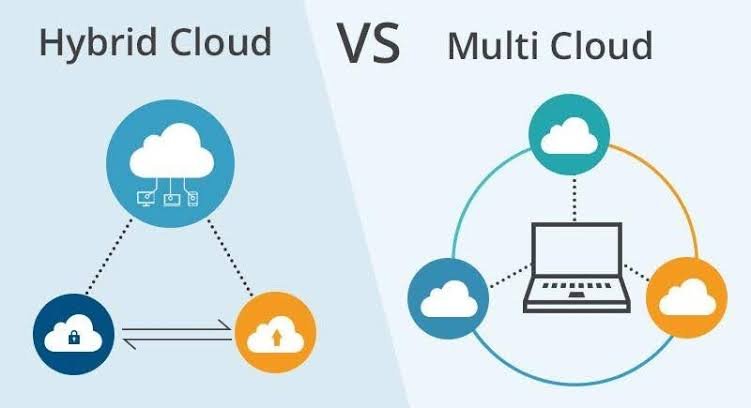
At first glance, hybrid cloud and multi-cloud may seem similar because both involve using more than one computing environment. In reality, they solve different problems and offer different advantages. Hybrid cloud combines private infrastructure with public cloud services, allowing businesses to connect systems that operate in different environments. Multi-cloud involves using services from multiple cloud providers, giving organizations the flexibility to select platforms according to their technical, financial, and operational needs.
Choosing between these strategies is not simply a technical decision. It can affect business costs, data security, application performance, regulatory compliance, disaster recovery, and long-term growth. A strategy that works well for a financial institution may not be suitable for a startup building a new digital product. Similarly, a company with strict data residency requirements may have different priorities from an online retailer that needs to handle unpredictable traffic.
In 2026, organizations are also considering how artificial intelligence, automation, edge computing, and increasingly complex cybersecurity requirements influence their cloud decisions.
Understanding the differences between hybrid cloud and multi-cloud can help businesses make informed choices instead of following technology trends without a clear purpose.
This article explores how both strategies work, their major benefits and limitations, the situations in which each approach makes sense, and the practical steps businesses can take to choose the right cloud strategy.
1. Understanding Hybrid Cloud
Hybrid cloud is a computing approach that combines private infrastructure with public cloud services and connects them in a coordinated environment.
Private infrastructure may include servers located in a company’s own data center, a privately hosted environment, or a dedicated cloud environment. Public cloud services are provided by companies that offer computing resources, storage, databases, networking, and other capabilities over the internet or private connections.
The defining feature of hybrid cloud is the integration between these environments. Applications and data can move between, or operate across, different parts of the infrastructure according to business requirements.
For example, a healthcare organization might keep certain sensitive records in a tightly controlled private environment while using public cloud services for website hosting, analytics, or less sensitive workloads. A manufacturing company might process critical operational data locally while using cloud resources for long-term analysis.
This approach allows businesses to retain control over selected systems without giving up the flexibility of public cloud infrastructure.
Hybrid cloud can also help organizations modernize gradually. Instead of moving every application to the public cloud at once, they can migrate suitable workloads while continuing to operate systems that depend on existing infrastructure.
However, a hybrid environment requires careful integration. Network connections, identity systems, security policies, data synchronization, and monitoring must work consistently across different environments.
Without proper planning, hybrid cloud can create additional complexity rather than simplify IT operations.
The goal is to combine the strengths of private and public infrastructure while maintaining a clear, manageable architecture.
2. Understanding Multi-Cloud
Multi-cloud refers to using cloud services from two or more cloud providers.
For example, a business might use one provider for application hosting, another for data analytics, and a third for specialized artificial intelligence services. Each provider offers different products, pricing models, infrastructure options, and technical capabilities.
Unlike hybrid cloud, multi-cloud does not necessarily require a private data center. A company can operate entirely through public cloud services and still follow a multi-cloud strategy if it uses multiple providers.
Organizations adopt multi-cloud for several reasons.
One reason is flexibility. Different providers may offer stronger capabilities for particular workloads. A business might choose one platform for its global infrastructure, another for managed data services, and another for a specialized AI application.
Another reason is risk management. Using multiple providers may reduce dependence on a single cloud company, although it does not automatically guarantee better reliability or disaster recovery.
Multi-cloud can also help businesses respond to regional requirements, commercial agreements, or differences in service availability.
For example, an international company might use different cloud providers in different markets to support local operations and meet particular requirements.
However, multi-cloud environments introduce their own challenges. Each provider may use different identity systems, monitoring tools, networking models, billing structures, and deployment processes.
Teams must understand these differences and establish consistent security and operational practices.
Using multiple providers simply to avoid dependence on one company can also increase costs and complexity if the business does not have a clear reason for distributing its workloads.
A successful multi-cloud strategy is therefore based on deliberate workload placement rather than using multiple providers for its own sake.
3. Hybrid Cloud vs. Multi-Cloud: The Key Differences
Although the two approaches can overlap, their primary differences relate to the environments being combined and the business objectives they support.
| Feature | Hybrid cloud | Multi-cloud |
|---|---|---|
| Basic structure | Combines private infrastructure with public cloud services | Uses services from multiple cloud providers |
| Main objective | Integrate private and public environments | Choose services across different providers |
| Private infrastructure | Usually a core component | Not required |
| Provider dependence | May use one or several public cloud providers | Uses at least two cloud providers |
| Typical benefit | Control over selected systems with cloud flexibility | Choice of providers and specialized capabilities |
| Main challenge | Integrating and securing different environments | Managing differences between cloud platforms |
| Common use case | Keeping sensitive workloads private while using public cloud resources | Using different providers for analytics, applications, and AI |
The distinction becomes clearer through an example.
Imagine a company that operates its own data center but also uses a public cloud for additional computing capacity. If it integrates those environments to run its business applications, it is following a hybrid cloud approach.
Now imagine that the same company uses two public cloud providers for different applications. That is a multi-cloud approach.
The company could also use its private data center alongside both public cloud providers. In that case, it would have a hybrid environment that also follows a multi-cloud strategy.
This overlap is important because hybrid cloud and multi-cloud are not necessarily competing choices. They describe different aspects of a cloud architecture.
The right decision depends on the organization’s infrastructure, business goals, technical requirements, and ability to manage complexity.
4. The Major Benefits of Hybrid Cloud
Hybrid cloud can be especially useful for organizations that need a combination of control, flexibility, and gradual modernization.
Greater control over sensitive data
Some businesses operate under strict legal, contractual, or internal requirements concerning how data is stored and accessed.
A hybrid environment allows them to retain selected systems within a private infrastructure while using public cloud resources for suitable workloads.
However, keeping data private does not automatically make it secure or compliant. Private environments still require access controls, encryption, monitoring, and appropriate governance.
Easier migration from legacy systems
Many established businesses depend on older applications that cannot be moved easily to modern cloud platforms.
Hybrid cloud allows organizations to modernize gradually rather than replacing every system at once. Existing applications can continue running while newer services are developed in the cloud.
Flexible computing capacity
Businesses may experience periods of increased demand that exceed the capacity of their existing infrastructure.
A properly designed hybrid environment can use public cloud resources to handle additional workloads when suitable, reducing the need to maintain enough private infrastructure for every possible demand peak.
This approach is sometimes called cloud bursting, although it requires applications, networking, and data systems that support it.
Support for specialized workloads
Some applications require particular hardware, low-latency local processing, or close integration with industrial equipment.
Hybrid cloud allows organizations to keep these workloads near the systems they serve while using public cloud resources for other activities.
Improved modernization flexibility
Hybrid cloud gives organizations more choices about where applications run and when they should move.
This flexibility can be valuable for businesses that must balance modernization with existing investments, operational continuity, and budget constraints.
Nevertheless, hybrid cloud requires ongoing management. Its benefits depend on whether the organization can integrate and maintain its different environments effectively.
5. The Major Benefits of Multi-Cloud
Multi-cloud offers a different set of advantages, particularly for organizations that want flexibility across cloud providers.
Access to specialized services
Cloud providers compete by offering different capabilities in areas such as AI, data analytics, application development, and global infrastructure.
A multi-cloud strategy allows businesses to select services that best match specific workloads instead of relying on one provider for everything.
Reduced dependence on one provider
Using multiple providers can reduce the concentration of some operational and commercial risks.
For example, an organization may be less exposed to a provider-specific service disruption if its critical workloads are genuinely distributed and capable of operating elsewhere.
However, simply having accounts with two providers does not provide resilience. Applications, data, authentication, and recovery procedures must be designed to support failover.
Greater negotiating flexibility
Organizations with substantial cloud spending may benefit from having more options when evaluating service pricing and commercial agreements.
However, migration costs, proprietary services, data transfer fees, and employee expertise can make switching providers difficult.
Geographic flexibility
Different providers may have different regional footprints and service availability.
A business operating internationally can evaluate which provider best meets the requirements of each market, subject to local regulations and practical constraints.
Support for innovation
Multi-cloud allows teams to experiment with different services without immediately committing every workload to one platform.
For example, a company might test a specialized AI service from one provider while continuing to run its core application on another.
The main advantage is choice. However, that choice creates value only when the benefits outweigh the additional cost and operational effort.
6. Security Considerations: Which Strategy Is Safer?
Security is one of the most important factors when choosing a cloud strategy, but neither hybrid cloud nor multi-cloud is automatically more secure.
A hybrid environment may offer greater direct control over selected infrastructure. However, organizations must secure the private environment and every connection between private systems and public cloud services.
A misconfigured network connection, outdated server, or overly permissive account can create a pathway for attackers.
Multi-cloud introduces a different challenge. Security controls must remain consistent across multiple providers, each of which may have different configuration tools, identity systems, and monitoring capabilities.
For example, an organization might enforce strong access controls in one cloud but overlook an administrative account in another.
To manage these risks, businesses should establish a common security framework across all environments.
Important practices include:
- Enabling multi-factor authentication for important accounts.
- Applying the principle of least privilege to users, applications, and automated services.
- Encrypting sensitive data in transit and at rest.
- Monitoring account activity, configuration changes, and suspicious network behavior.
- Maintaining reliable, protected backups.
- Reviewing software dependencies and third-party integrations.
- Testing incident response and recovery procedures regularly.
Centralized identity management can help organizations maintain consistent access policies, while security monitoring platforms can bring together relevant information from different environments.
Automation can also detect configuration errors and enforce approved security settings.
Ultimately, security depends more on architecture, implementation, monitoring, and governance than on the number of cloud providers an organization uses.
7. Cost Comparison: Which Approach Is More Affordable?
Cost is often a major consideration in cloud planning. However, there is no universal rule that hybrid cloud or multi-cloud is cheaper.
The total cost depends on infrastructure requirements, workload patterns, service pricing, staffing, data transfer, licensing, and ongoing maintenance.
Hybrid cloud may allow businesses to continue using existing infrastructure rather than moving every workload to the public cloud. This can be useful when certain systems are already well supported by existing hardware.
However, private infrastructure involves costs for equipment, facilities, electricity, maintenance, upgrades, and technical staff. Integrating it with public cloud services can also require additional networking and management tools.
Multi-cloud may allow businesses to select competitively priced services or use specialized offerings that improve productivity.
At the same time, running workloads across several providers can increase costs through duplicated tools, additional training, data transfer charges, and separate support agreements.
A company may also spend more on cloud resources than expected if workloads are distributed without clear ownership or budget controls.
To compare the strategies effectively, organizations should calculate the total cost of ownership rather than looking only at advertised computing prices.
A useful assessment includes:
- Infrastructure and cloud service charges.
- Data transfer and network connectivity costs.
- Software licensing and support agreements.
- Security, monitoring, and management tools.
- Employee training and operational staffing.
- Migration and application modernization expenses.
- Backup, disaster recovery, and compliance requirements.
Cloud cost management tools can help identify unused resources, unusual spending patterns, and opportunities to improve efficiency.
The best strategy is the one that meets business requirements at a sustainable total cost, not necessarily the one with the lowest initial price.
8. Performance, Reliability, and Disaster Recovery
Cloud strategy can influence how quickly applications respond and how reliably they remain available.
Hybrid cloud may be useful when certain applications need to run close to physical equipment, local users, or existing databases. Keeping processing close to the source of data can reduce network delays and support time-sensitive operations.
However, applications that depend on communication between private infrastructure and a public cloud can experience delays if network connections are unreliable or poorly designed.
Multi-cloud can improve resilience when workloads are distributed intelligently across providers. If one provider experiences a serious disruption, another environment may be able to support essential operations.
Yet this is not automatic. A second cloud provider does not help if the application cannot run there, the necessary data is unavailable, or the organization has not tested its recovery procedures.
Businesses should identify their recovery time objective (RTO), which defines how quickly a system must be restored, and their recovery point objective (RPO), which defines how much recent data loss is acceptable.
These objectives help determine whether a workload needs simple backups, replicated data, standby infrastructure, or active operation across multiple environments.
Testing is essential. Organizations should regularly simulate failures and confirm that applications can recover within their required time frames.
For some businesses, a well-managed single-cloud deployment with strong backups may provide better value than a complicated multi-cloud architecture.
Reliability comes from deliberate design, tested recovery processes, and appropriate redundancy—not merely from having more infrastructure.
9. Hybrid Cloud and Multi-Cloud in the Age of AI
Artificial intelligence is creating new opportunities and challenges for cloud architecture.
AI applications often require substantial computing resources, access to large datasets, specialized processors, and efficient data pipelines. Different providers may offer different combinations of AI models, accelerators, development tools, and managed services.
Multi-cloud can allow businesses to select specialized AI services according to the needs of each project.
For example, a company might use one provider for its main business applications and another for a particular AI model or analytics service.
However, moving large datasets between providers can be expensive and slow. Organizations must also consider data privacy, model availability, access controls, and the difficulty of migrating applications that depend on provider-specific features.
Hybrid cloud can be useful when businesses need to keep sensitive information within controlled environments while using public cloud resources for selected AI workloads.
For instance, a company might perform certain data preparation tasks locally and send only approved information to an external AI service.
This arrangement requires careful attention to data handling and privacy requirements. Keeping data in a private environment does not guarantee that an application will avoid transmitting sensitive information elsewhere.
Edge computing can add another dimension. Some AI applications need to process information close to connected devices because of latency, bandwidth, or operational requirements.
A company may therefore use a combination of private infrastructure, public cloud services, and edge systems.
As AI adoption grows, cloud strategy will increasingly depend on where data resides, where computing takes place, and how services can work together securely.
10. Industry Examples: Which Strategy Fits Different Businesses?
Different industries have different cloud requirements, so the right strategy depends on the nature of the work being performed.
Healthcare
Healthcare organizations often manage sensitive patient information and must meet applicable privacy and security requirements.
A hybrid approach may suit organizations that need to retain selected systems in controlled environments while using public cloud services for appropriate analytics, scheduling, collaboration, or application hosting.
Multi-cloud may also be appropriate when specific services offer useful capabilities, provided data handling and compliance obligations are managed carefully.
Financial services
Banks and financial institutions often prioritize security, resilience, auditability, and regulatory compliance.
Some may use hybrid environments to integrate established systems with newer cloud-based applications. Others may use multiple providers to support particular workloads or geographic operations.
The decision should be based on the relevant regulations, system requirements, risk assessments, and operational capabilities.
Retail and e-commerce
Retailers experience changing demand during promotions, holidays, and major shopping events.
Public cloud services can provide flexible capacity for online stores, inventory systems, and customer-facing applications.
A multi-cloud approach may be useful when retailers need specialized analytics or AI services from different providers. A hybrid environment may suit businesses that retain local systems for stores, warehouses, or existing enterprise applications.
Manufacturing
Manufacturers may operate machinery, sensors, and industrial systems that require local processing and dependable connectivity.
Hybrid cloud can support these requirements by keeping time-sensitive workloads near production equipment while sending selected information to the cloud for analysis.
Multi-cloud may provide access to different analytics or AI capabilities, but the architecture must account for operational reliability and the consequences of service interruptions.
Startups and small businesses
Startups often need to move quickly while keeping spending manageable.
A straightforward public cloud deployment may be sufficient at first. Multi-cloud can add unnecessary complexity if there is no clear business reason to use multiple providers.
Hybrid cloud may also be unnecessary for a business without existing infrastructure or specific data control requirements.
As the company grows, its needs can be reassessed rather than designing an unnecessarily complicated environment from the beginning.
11. Common Mistakes to Avoid
Choosing a cloud strategy can become difficult when organizations focus on technology trends instead of their actual needs.
One common mistake is adopting multi-cloud simply to avoid vendor lock-in. Although provider diversity can offer flexibility, distributing applications across multiple platforms may increase costs and require substantial engineering work.
Another mistake is assuming hybrid cloud automatically improves data security. Private infrastructure still needs proper maintenance, access control, encryption, and monitoring.
Businesses can also underestimate the difficulty of moving data between environments. Large datasets, incompatible application designs, network costs, and differences between provider services can make migration more challenging than expected.
Poor governance is another frequent problem. Without clear ownership, teams may create cloud resources independently, leading to duplicated spending, inconsistent security controls, and unnecessary complexity.
Organizations should also avoid designing disaster recovery plans that exist only on paper. Recovery systems must be tested to confirm that they work under realistic conditions.
Finally, businesses should not overlook the people involved. Engineers need suitable training, security teams require visibility across the environment, and financial teams need reliable information about cloud spending.
A successful cloud strategy combines technical design with clear responsibilities, realistic budgets, and measurable business objectives.
12. How to Choose the Right Cloud Strategy for Your Business
The best way to choose between hybrid cloud and multi-cloud is to begin with business requirements rather than selecting a platform first.
Step 1: Identify your business priorities
Determine what matters most to your organization. Priorities might include controlling sensitive data, reducing operational costs, improving performance, supporting global growth, or accessing specialized AI services.
These goals will help establish which architecture makes sense.
Step 2: Assess your existing infrastructure
If your organization operates a data center or depends on legacy systems, hybrid cloud may provide a practical path toward modernization.
If your applications already operate primarily in the public cloud, multi-cloud may be worth considering when different providers offer meaningful advantages.
Step 3: Evaluate compliance and data requirements
Identify applicable regulations, contractual commitments, data residency needs, and internal security policies.
These requirements may influence where data can be stored, how it can be processed, and which providers are suitable.
Step 4: Compare costs and operational complexity
Estimate not only cloud service charges but also the cost of staffing, integration, monitoring, migration, and ongoing support.
Consider whether your team has the skills and resources to manage the proposed environment.
Step 5: Review reliability requirements
Decide how quickly essential systems must recover after a failure and how much data loss is acceptable.
Then determine whether backups, regional redundancy, hybrid infrastructure, or multi-provider deployment offers the most practical solution.
Step 6: Start with a limited project
Rather than redesigning the entire IT environment, test the strategy with a suitable workload.
Measure performance, cost, security, and operational effort before expanding the approach.
Step 7: Review the strategy regularly
Business needs and cloud services change over time. Regular reviews help organizations identify unnecessary complexity, new opportunities, and areas where existing arrangements no longer provide sufficient value.
A cloud strategy should be treated as an evolving business decision rather than a permanent commitment that can never be reconsidered.
13. Can Businesses Combine Hybrid Cloud and Multi-Cloud?
Yes. In fact, some organizations benefit from combining both strategies.
A business might retain selected applications in a private environment while using two public cloud providers for different workloads. This creates a hybrid and multi-cloud architecture.
For example, a manufacturing company could keep production control systems close to its facilities, use one cloud provider for its main business applications, and use another for specialized data analytics.
A global organization might also use multiple providers while maintaining private infrastructure for workloads with particular security or performance requirements.
This flexibility can be valuable, but it increases the importance of governance and integration.
Organizations need consistent identity policies, centralized monitoring, reliable network connectivity, and clear rules governing data movement between environments.
They must also understand which systems depend on provider-specific services and how those dependencies affect recovery and migration.
Not every business needs this level of complexity. Combining hybrid cloud and multi-cloud should be justified by measurable benefits, such as better performance, essential regulatory controls, or meaningful resilience improvements.
For smaller organizations, a simpler architecture may be easier to secure, operate, and afford.
The objective is not to use every available cloud option. It is to create an environment that supports business needs without introducing unnecessary technical and financial burdens.
14. The Future of Cloud Strategy
Cloud computing will continue to evolve as businesses adopt AI, automation, edge computing, and increasingly data-intensive applications.
AI-assisted operations may help organizations monitor cloud spending, identify configuration problems, optimize resource allocation, and improve system performance.
At the same time, AI workloads may encourage businesses to evaluate multiple providers because no single platform necessarily offers the best combination of models, hardware, data services, and pricing for every application.
Hybrid environments are also likely to remain relevant where organizations need to integrate existing systems, meet specific data requirements, or process information close to physical operations.
Security will become increasingly important as cloud architectures grow more distributed. Businesses will need consistent identity controls, clear data governance, and effective monitoring across every environment they operate.
Sustainability may also influence cloud decisions. Organizations are increasingly interested in energy efficiency, resource utilization, and the environmental impact of their computing workloads.
However, future cloud strategies will not necessarily become more complicated for everyone. Some businesses may benefit from managed platforms that reduce the need to operate infrastructure directly, while others may require carefully integrated environments to support specialized operations.
The strongest trend is toward greater flexibility, but flexibility must be balanced with simplicity, security, and cost control.
Businesses that evaluate cloud decisions according to their actual requirements will be better positioned to adapt as technology changes.
Conclusion
Hybrid cloud and multi-cloud are two important strategies for organizations seeking flexibility, scalability, and better control over their digital infrastructure. Although they are related, they address different needs.
Hybrid cloud combines private infrastructure with public cloud services, making it useful for businesses that need to integrate existing systems, retain control over selected workloads, or modernize gradually.
Multi-cloud uses services from multiple cloud providers, allowing organizations to choose specialized capabilities, reduce certain forms of provider dependence, and distribute workloads according to their requirements.
Neither strategy is automatically cheaper, safer, or more reliable than the other. Both require careful planning, appropriate security controls, effective monitoring, and a realistic understanding of operational complexity.
For some organizations, hybrid cloud will provide the right balance between control and flexibility. Others may benefit from multi-cloud because different providers offer distinct advantages. Some businesses may eventually combine both approaches, while others will find that a simpler single-cloud architecture better meets their needs.
The most important step is to begin with clear business objectives. By evaluating existing infrastructure, data requirements, costs, security obligations, and recovery needs, organizations can make a more informed decision.
Ultimately, successful cloud strategy is not about choosing the most complicated architecture or following the latest trend. It is about building a reliable, secure, and cost-effective technology environment that helps the business operate efficiently today while remaining prepared for tomorrow’s opportunities.