
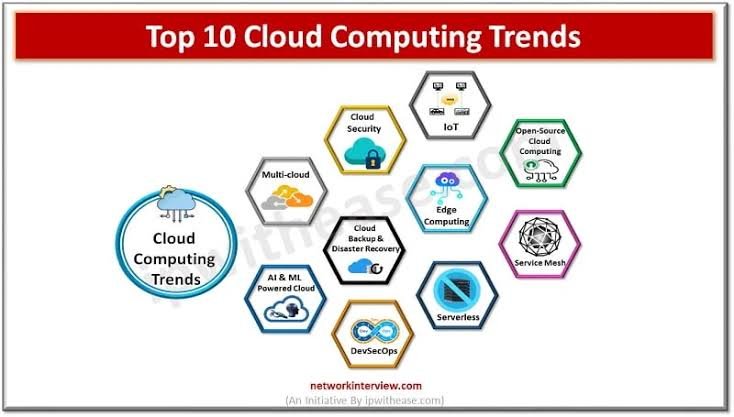
Cloud computing has moved far beyond being simply a way to store files and run applications online. Today, it is one of the most important technologies driving digital transformation across almost every industry. From artificial intelligence and machine learning to cybersecurity and edge computing, the cloud is becoming the foundation for how businesses build, operate, and scale digital services.
As technology continues to evolve, organizations are looking for faster, smarter, more secure, and more cost-effective ways to use cloud infrastructure. This is creating new opportunities while also changing how companies approach their IT strategies.
So, what does the future of cloud computing look like?
In this article, we explore 10 cloud computing trends that are expected to shape the future, along with why they matter for businesses, developers, and technology professionals.
1. Artificial Intelligence and Cloud Computing
Artificial intelligence (AI) is one of the biggest forces shaping the future of cloud computing.
AI applications require significant computing power, storage, and access to large amounts of data. Cloud platforms make these resources available without requiring every organization to purchase and maintain expensive specialized hardware.
Businesses can use cloud-based AI services for tasks such as:
- Customer service automation
- Predictive analytics
- Fraud detection
- Recommendation systems
- Image and speech recognition
- Data analysis
- Generative AI applications
Generative AI is making this trend even more important. Companies are increasingly using cloud infrastructure to develop, train, deploy, and scale AI-powered applications.
The relationship works both ways. AI is benefiting from cloud computing, while AI is also being used to make cloud environments more automated and intelligent.
In the coming years, expect AI and cloud computing to become increasingly interconnected.
2. The Growth of Edge Computing
Cloud computing traditionally involves sending data to centralized data centers for processing. However, some applications need information to be processed much closer to where it is generated.
This is where edge computing comes in.
Edge computing moves certain processing tasks closer to users, devices, sensors, and other sources of data. Instead of sending every piece of information to a distant cloud data center, some data can be analyzed locally or at nearby edge locations.
This can be particularly useful for applications where low latency is important, including:
- Autonomous vehicles
- Smart cities
- Industrial automation
- Healthcare technology
- Internet of Things (IoT) devices
- Real-time video analytics
Edge computing is not necessarily replacing the cloud. Instead, the two technologies can work together. The cloud can provide centralized storage, analytics, and management, while edge infrastructure handles time-sensitive processing closer to the source.
3. Serverless Computing Will Continue to Expand
Serverless computing is another important cloud computing trend.
Despite its name, serverless computing still uses servers. The difference is that developers do not have to manage the underlying server infrastructure themselves.
Cloud providers automatically handle much of the infrastructure management, allowing developers to focus primarily on writing and deploying application code.
One major advantage of serverless architecture is that resources can be allocated based on demand. Developers can build applications without having to constantly manage server capacity.
Serverless computing can be especially useful for event-driven applications, APIs, automation workflows, and applications with unpredictable traffic.
As companies look for ways to reduce infrastructure management and development complexity, serverless computing is likely to remain an important part of modern cloud architecture.
4. Multi-Cloud Strategies Will Become More Common
Instead of relying on a single cloud provider, many organizations are adopting multi-cloud strategies.
A multi-cloud approach means using services from more than one cloud provider. Businesses may choose this strategy for several reasons, including flexibility, performance, resilience, and access to specialized services.
For example, an organization might use one provider for analytics, another for a specific AI service, and another for certain applications or infrastructure.
Multi-cloud strategies can reduce dependence on a single provider, but they also introduce challenges.
Managing multiple cloud platforms can increase complexity, especially when it comes to:
- Security
- Monitoring
- Cost management
- Data movement
- Compliance
- Employee skills
- Application integration
As cloud environments become more complex, organizations will need better tools for managing multiple providers from a centralized perspective.
5. Cloud Security Will Become More Advanced
As more sensitive information and critical applications move to the cloud, cloud security will remain a major priority.
Cyber threats are becoming more sophisticated, and organizations cannot afford to treat security as an afterthought.
Future cloud security strategies will increasingly focus on identity, access control, encryption, continuous monitoring, automated threat detection, and zero-trust security principles.
Artificial intelligence may also play a larger role in identifying unusual behavior and potential threats.
Businesses will need to protect not only their cloud infrastructure but also applications, APIs, accounts, devices, and data.
The future of cloud computing will therefore depend heavily on the ability to make cloud environments both scalable and secure.
6. Cloud Cost Optimization Will Become Essential
Cloud computing can reduce infrastructure costs, but simply moving to the cloud does not guarantee that a company will save money.
Organizations can easily spend more than expected if cloud resources are poorly managed.
This is why FinOps and cloud cost optimization are becoming increasingly important.
FinOps brings financial management and cloud operations together. It helps organizations understand where cloud money is being spent and encourages teams to make better decisions about resource usage.
Businesses are increasingly looking at tools and strategies that can:
- Identify unused resources
- Reduce unnecessary workloads
- Optimize storage
- Monitor cloud spending
- Improve resource utilization
- Forecast future expenses
As cloud adoption grows, managing cloud costs will become just as important as managing cloud performance.
7. The Rise of Industry-Specific Cloud Solutions
Another significant trend is the growth of industry cloud platforms.
Instead of offering generic cloud services for everyone, providers and technology companies are developing cloud solutions tailored to specific industries.
Healthcare, financial services, manufacturing, retail, government, and other sectors have unique requirements. They may need specialized security controls, regulatory compliance features, workflows, and data management capabilities.
Industry-specific cloud platforms can help organizations adopt cloud technology while addressing these specialized requirements.
For example, a healthcare organization may need infrastructure designed around privacy and regulatory requirements, while a financial institution may prioritize security, risk management, and transaction processing.
This trend could make cloud adoption easier for organizations that previously found general-purpose cloud platforms difficult to adapt to their needs.
8. Automation Will Transform Cloud Management
Cloud environments can become extremely complicated as organizations deploy hundreds or thousands of applications and resources.
Manual management does not scale well.
As a result, automation is becoming increasingly important in cloud computing.
Organizations are using automation to manage infrastructure, deploy applications, monitor systems, respond to incidents, and optimize resources.
Infrastructure as Code (IaC) is one example. It allows teams to define infrastructure through configuration files rather than manually creating every resource.
Automation can improve consistency, reduce human error, and help organizations deploy changes more quickly.
In the future, AI-powered automation could take this even further by identifying problems and recommending or performing certain corrective actions automatically.
The goal is not simply to automate repetitive tasks but to create cloud environments that can respond intelligently to changing conditions.
9. Sustainability and Green Cloud Computing
Environmental sustainability is becoming a more important consideration in technology.
Data centers consume significant amounts of electricity, particularly as demand for AI and other computing-intensive workloads grows.
This is increasing interest in green cloud computing and more energy-efficient infrastructure.
Cloud providers are investing in technologies designed to improve data-center efficiency, increase renewable energy usage, and reduce environmental impact.
Organizations are also beginning to consider sustainability when selecting cloud services and designing applications.
Future cloud architectures may place greater emphasis on efficient computing, intelligent workload scheduling, optimized hardware, and renewable energy sources.
For businesses, sustainability may eventually become an important part of cloud procurement and IT decision-making rather than simply a corporate responsibility initiative.
10. Cloud-Native Development Will Become the Standard
Cloud-native technology is changing how modern applications are designed and delivered.
Rather than taking traditional applications and simply moving them to cloud servers, organizations are increasingly building applications specifically to take advantage of cloud capabilities.
Cloud-native development commonly involves technologies and approaches such as:
- Containers
- Microservices
- Kubernetes
- APIs
- DevOps
- Continuous integration and continuous delivery
- Infrastructure as Code
These approaches can make applications more flexible and easier to scale.
For developers, cloud-native architecture can provide greater freedom to build applications that can respond to changing demand.
As businesses continue modernizing their software, cloud-native development is likely to become increasingly common.
What Do These Cloud Trends Mean for Businesses?
The trends above show that cloud computing is becoming much more than an infrastructure choice.
It is becoming a strategic technology platform.
Businesses that want to remain competitive will need to think carefully about how they use cloud services. Simply moving existing systems to the cloud may not be enough.
Organizations should consider questions such as:
- Which workloads actually belong in the cloud?
- How can cloud costs be controlled?
- How should sensitive data be protected?
- Can automation improve operations?
- Should the company use one cloud provider or several?
- How can AI improve existing products and services?
- Which applications should use edge computing?
- How can the organization reduce its environmental impact?
Answering these questions can help businesses create a cloud strategy that supports both current requirements and future growth.
How Will These Trends Affect Cloud Computing Careers?
The evolution of cloud computing is also creating new opportunities for technology professionals.
Traditional IT skills remain valuable, but employers increasingly need people who understand cloud architecture, cybersecurity, automation, data engineering, AI, DevOps, and cloud-native development.
Some of the roles likely to remain in demand include:
- Cloud engineers
- Cloud architects
- DevOps engineers
- Cloud security specialists
- Data engineers
- AI and machine learning engineers
- Site reliability engineers
- Cloud administrators
For beginners, learning the fundamentals of cloud computing can therefore be a strong starting point for developing a technology career.
Final Thoughts
The future of cloud computing is being shaped by several powerful technologies and changing business requirements.
Artificial intelligence, edge computing, serverless architecture, multi-cloud strategies, cybersecurity, FinOps, industry-specific platforms, automation, sustainability, and cloud-native development are all influencing how organizations will use the cloud in the years ahead.
The most important thing to remember is that these trends do not exist independently. They are increasingly connected.
AI needs scalable cloud infrastructure. Edge computing works alongside centralized cloud platforms. Automation helps manage increasingly complex environments. Security must be built into every layer, while sustainability and cost optimization are becoming essential considerations.
For businesses, developers, students, and IT professionals, understanding these cloud computing trends can provide valuable insight into where technology is heading.
Cloud computing has already transformed the digital world. The next generation of cloud technology could transform it even further.