
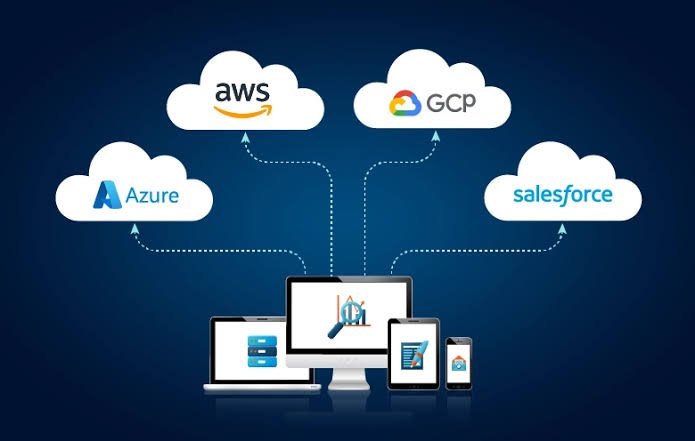
Cloud computing has given businesses more flexibility than ever before. Organizations can use cloud infrastructure to host applications, store data, run databases, build artificial intelligence solutions, analyze information, and support employees from almost anywhere.
As cloud adoption has grown, many businesses have realized that they don’t necessarily have to rely on just one cloud provider.
Instead, they can use services from multiple cloud platforms.
This approach is known as a multi-cloud strategy.
A multi-cloud strategy can help organizations choose different cloud services based on performance, cost, geographic availability, technical capabilities, and business requirements. However, managing multiple cloud environments can also introduce additional complexity.
So, what exactly is multi-cloud computing? Why do businesses use it, and what are the challenges?
This complete guide explains what a multi-cloud strategy is, how it works, its benefits and disadvantages, common use cases, security considerations, and best practices for building an effective multi-cloud environment.
What Is a Multi-Cloud Strategy?
A multi-cloud strategy is an approach in which an organization uses cloud services from two or more cloud providers.
For example, a company might use:
- AWS for application hosting
- Microsoft Azure for specific enterprise services
- Google Cloud for data analytics or artificial intelligence
The organization doesn’t necessarily need to use the same type of service from every provider.
Instead, it can select the cloud platform that best fits a particular workload.
A multi-cloud environment can include public cloud providers, specialized cloud services, and sometimes private infrastructure, although using private infrastructure alongside public clouds is more specifically associated with a hybrid cloud strategy.
Multi-Cloud vs. Hybrid Cloud
Multi-cloud and hybrid cloud are sometimes confused, but they describe different concepts.
Multi-Cloud
Multi-cloud means using multiple cloud providers.
For example:
AWS + Azure + Google Cloud
Hybrid Cloud
Hybrid cloud means combining private or on-premises infrastructure with public cloud services.
For example:
Private Data Center + AWS
An organization can also have both strategies at the same time.
For example:
Private Infrastructure + AWS + Azure + Google Cloud
This would represent both a hybrid and multi-cloud environment.
Why Do Businesses Use a Multi-Cloud Strategy?
There isn’t one reason why companies choose multi-cloud.
Different organizations have different motivations.
Common reasons include:
- Avoiding excessive dependence on one provider
- Accessing specialized services
- Improving resilience
- Supporting geographic requirements
- Optimizing costs
- Meeting business requirements
- Taking advantage of provider-specific technologies
Instead of asking, “Which cloud provider should we use for everything?” organizations can ask, “Which cloud provider is best for this particular workload?”
Benefits of a Multi-Cloud Strategy
A well-designed multi-cloud strategy can provide several advantages.
1. Avoiding Vendor Lock-In
One of the most commonly discussed benefits of multi-cloud computing is reduced dependence on a single provider.
If an organization uses only one cloud platform, moving away from that provider may become difficult if applications rely heavily on provider-specific services.
Using multiple providers can give businesses more flexibility.
However, multi-cloud doesn’t automatically eliminate vendor lock-in.
An application can still become highly dependent on individual provider services.
2. Access to Specialized Services
Different cloud providers offer different technologies, services, and strengths.
A business might prefer one provider for machine learning, another for enterprise integration, and another for a particular infrastructure requirement.
A multi-cloud strategy allows organizations to select services based on capabilities rather than forcing every workload onto one platform.
3. Greater Flexibility
Organizations can choose the cloud environment that best matches each workload.
For example, a company may deploy a customer-facing application on one provider while using another provider for data processing.
This can make technology decisions more flexible.
4. Improved Resilience
Using multiple providers can potentially reduce dependence on one provider’s infrastructure.
If a major service disruption affects one environment, some workloads may continue operating elsewhere.
However, genuine resilience requires careful architecture.
Simply having accounts with multiple cloud providers does not automatically create redundancy.
5. Geographic Requirements
Organizations operating internationally may have different requirements for data location, latency, or service availability.
Multiple cloud providers can provide additional options for deploying workloads in different geographic areas.
6. Cost Optimization
Different providers may offer different pricing models.
Organizations can compare costs and potentially select the most appropriate environment for particular workloads.
However, multi-cloud cost management can be complicated because pricing structures, discounts, data-transfer costs, and billing systems differ between providers.
7. Supporting Business Requirements
Large enterprises may already have relationships, applications, or skills associated with multiple cloud platforms.
A multi-cloud strategy can allow them to build on those existing investments instead of forcing everything into one environment.
Challenges of a Multi-Cloud Strategy
Multi-cloud isn’t automatically easier or cheaper.
Managing several cloud platforms can introduce significant challenges.
1. Increased Complexity
Each cloud provider has its own:
- Management tools
- APIs
- Services
- Security controls
- Pricing models
- Networking technologies
- Identity systems
IT teams need to understand how these environments work together.
2. Security Management
Securing one cloud environment can be challenging.
Securing multiple environments can be even more complicated.
Organizations need consistent approaches to:
- Identity
- Access control
- Encryption
- Logging
- Monitoring
- Vulnerability management
How to Manage It
Use centralized security policies where possible and maintain clear ownership of security responsibilities.
3. Skills Requirements
A multi-cloud strategy can require professionals who understand multiple cloud platforms.
An engineer may need knowledge of AWS, Azure, and Google Cloud instead of specializing in just one.
This can increase training requirements.
4. Cost Management
Each provider uses different billing systems and pricing structures.
Tracking total spending across multiple platforms can therefore become difficult.
Organizations should establish centralized cost reporting and clear ownership of cloud resources.
5. Data Transfer Costs
Moving information between cloud providers can generate network traffic and additional costs.
Data transfer can also introduce latency.
Before designing a multi-cloud architecture, businesses should understand where data will be stored and how frequently it needs to move.
6. Application Portability
Applications aren’t automatically portable between cloud platforms.
A system designed around provider-specific services may require significant changes before it can run elsewhere.
Organizations should consider portability during application design if multi-cloud flexibility is an important goal.
7. Operational Complexity
Monitoring, troubleshooting, deployment, and incident response become more complicated when applications span multiple providers.
Teams need clear procedures for identifying where problems occur and who is responsible for resolving them.
Common Multi-Cloud Use Cases
Multi-cloud strategies are used in many different situations.
1. Large Enterprise Applications
Large organizations may operate applications across multiple cloud providers based on technical and business requirements.
Different departments may also have different cloud preferences.
2. Artificial Intelligence and Machine Learning
An organization might use a particular provider for specialized AI infrastructure or machine learning services while using another provider for general application hosting.
3. Disaster Recovery
Organizations may use multiple cloud platforms as part of a broader disaster recovery strategy.
Critical workloads can potentially be replicated or recovered in another environment.
However, recovery architecture must be designed and tested carefully.
4. Global Applications
International businesses may use multiple cloud providers to improve availability or meet geographic requirements.
5. Mergers and Acquisitions
When companies merge, they may inherit infrastructure from different cloud providers.
Rather than immediately migrating everything to one platform, the organization may temporarily or permanently operate multiple environments.
6. Avoiding Provider Dependency
Some businesses intentionally design systems around multiple providers to maintain greater flexibility.
This can be particularly important for organizations that consider cloud portability strategically important.
Multi-Cloud Security Best Practices
Security should be considered from the beginning of a multi-cloud strategy.
Use Centralized Identity Management
Where practical, integrate cloud environments with consistent identity and access management processes.
Apply Least Privilege
Users and applications should receive only the permissions they require.
Enable Multi-Factor Authentication
Protect privileged accounts and other important identities with strong authentication.
Encrypt Sensitive Data
Protect sensitive information both while stored and while transmitted.
Centralize Monitoring
Collect and analyze relevant security and operational information across cloud environments.
Review Configurations
Regularly check for insecure settings, excessive permissions, exposed resources, and other configuration problems.
Protect Secrets
Credentials, API keys, and other secrets should be stored securely rather than embedded in source code or configuration files.
Multi-Cloud Management Tools
Managing multiple cloud platforms manually can become difficult.
Organizations often use cloud management and automation technologies to simplify operations.
These can include:
- Infrastructure as Code
- Configuration management
- Container platforms
- Kubernetes
- CI/CD tools
- Monitoring platforms
- Security management tools
Infrastructure as Code can be particularly useful because teams can define infrastructure using reusable configurations.
However, tools should be selected based on actual requirements rather than adopting them simply because they support multiple clouds.
The Role of Kubernetes in Multi-Cloud
Containers can make application deployment more consistent across different environments.
Kubernetes is widely used for orchestrating containerized workloads.
An organization may run Kubernetes clusters across multiple cloud providers.
This can provide a degree of application portability.
However, Kubernetes does not automatically solve every multi-cloud problem.
Networking, storage, security, identity, observability, data management, and provider-specific services still need to be considered.
Multi-Cloud Cost Optimization
Cost management is especially important in multi-cloud environments.
Businesses should establish clear visibility into spending.
Useful practices include:
- Resource tagging
- Budget alerts
- Usage monitoring
- Rightsizing
- Automated shutdown of unused resources
- Regular cost reviews
- Centralized reporting
Organizations should also pay close attention to data-transfer costs.
An architecture that looks inexpensive based on compute pricing may become more expensive if large amounts of information constantly move between providers.
How to Create a Multi-Cloud Strategy
A successful multi-cloud strategy should begin with business requirements.
Step 1: Define Your Objectives
Determine why the organization wants to use multiple cloud providers.
Is the goal:
- Resilience?
- Cost optimization?
- Specialized services?
- Geographic coverage?
- Avoiding vendor dependence?
Step 2: Assess Existing Workloads
Identify applications, databases, data, infrastructure, and dependencies.
Step 3: Select Appropriate Providers
Choose cloud providers based on workload requirements rather than popularity alone.
Step 4: Design the Architecture
Determine how applications, networks, identities, and data will communicate across environments.
Step 5: Establish Security Standards
Create consistent policies for identity, access, encryption, logging, and monitoring.
Step 6: Automate Infrastructure
Use Infrastructure as Code and automation to reduce manual configuration.
Step 7: Monitor Costs and Performance
Track cloud spending, application performance, availability, and resource usage.
Step 8: Test Failure Scenarios
If resilience is one of your goals, test what happens when a cloud service or provider becomes unavailable.
Multi-Cloud Best Practices
Organizations can improve their multi-cloud strategy by following several principles:
- Have a clear business reason for using multiple clouds.
- Avoid unnecessary complexity.
- Standardize security policies.
- Use strong identity management.
- Automate infrastructure where practical.
- Monitor all environments.
- Track costs centrally.
- Document dependencies.
- Minimize unnecessary data movement.
- Test disaster recovery.
- Train teams across relevant cloud platforms.
- Regularly review the architecture.
Multi-cloud should solve a business problem.
Using several cloud providers simply for the sake of saying that you are “multi-cloud” can create unnecessary complexity without delivering meaningful benefits.
Is Multi-Cloud Right for Every Business?
No.
For many small businesses, using one cloud provider may be simpler and more cost-effective.
A multi-cloud strategy becomes more attractive when an organization has specific requirements that justify the additional complexity.
Consider multi-cloud if your business needs:
- Multiple specialized cloud services
- Provider flexibility
- Geographic options
- Additional resilience
- Support for different business units
- A strategy for reducing provider dependency
If those benefits aren’t important, a single-cloud strategy may be easier to operate.
Frequently Asked Questions
What is a multi-cloud strategy?
A multi-cloud strategy involves using services from two or more cloud providers within an organization’s technology environment.
What is an example of multi-cloud computing?
A company might use AWS for application infrastructure, Microsoft Azure for enterprise integration, and Google Cloud for data analytics.
Is multi-cloud better than single-cloud?
Not necessarily.
Multi-cloud can provide flexibility and access to multiple providers, but it also increases management, security, networking, and cost complexity.
Does multi-cloud prevent vendor lock-in?
It can reduce dependence on one provider, but it doesn’t completely eliminate vendor lock-in. Applications may still depend heavily on provider-specific services.
Is multi-cloud expensive?
It can be. Organizations need to consider cloud usage, data transfer, management tools, security, staffing, and operational costs across multiple platforms.
Can small businesses use multi-cloud?
Yes, but small businesses should carefully evaluate whether the benefits justify the additional complexity. In many cases, starting with one cloud provider may be simpler.
Final Thoughts
A multi-cloud strategy allows organizations to use cloud services from multiple providers instead of depending entirely on one platform.
It can provide flexibility, access to specialized services, additional resilience options, geographic choices, and greater control over technology decisions.
However, multi-cloud also introduces challenges.
Managing multiple cloud platforms requires more skills, stronger governance, better security practices, and greater operational visibility. Data transfer, application portability, cost management, and troubleshooting can also become more complicated.
The key is to have a clear reason for adopting multi-cloud.
Organizations should identify their business requirements first and then determine whether multiple providers actually provide meaningful value.
For some companies, a single cloud platform will be the most practical choice.
For others, multi-cloud can be a strategic advantage.
When carefully designed and managed, a multi-cloud environment can give organizations the flexibility to choose the right technology for the right workload while reducing excessive dependence on any single cloud provider.