
Cloud computing has become an important part of modern business infrastructure. Organizations use cloud platforms to host applications, store data, analyze information, support employees, and build new digital services.
However, not every workload has the same requirements.
Some applications may benefit from the scalability and flexibility of public cloud infrastructure, while other systems may need greater control over data, infrastructure, or security. Instead of choosing only one environment, organizations can combine different cloud models.
This is where hybrid cloud computing comes in.
Hybrid cloud computing allows organizations to connect private infrastructure with public cloud services so that workloads and data can operate across both environments.
This approach can provide flexibility and help businesses use the right infrastructure for different workloads.
In this guide, we’ll explain what hybrid cloud computing is, how it works, its major benefits and challenges, common use cases, security considerations, and how businesses can develop an effective hybrid cloud strategy.
What Is Hybrid Cloud Computing?
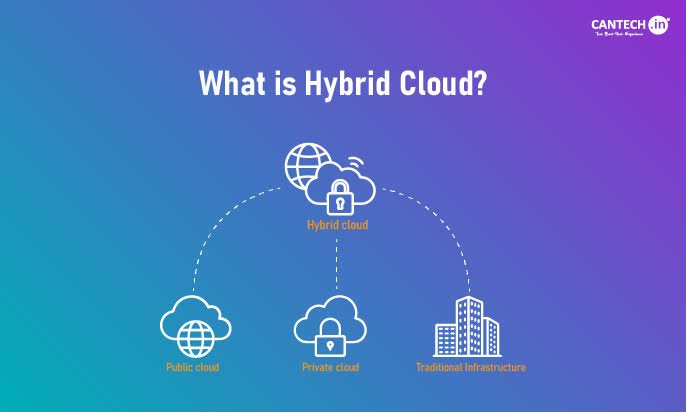
Hybrid cloud computing is an IT environment that combines private infrastructure with public cloud resources and enables them to work together.
A hybrid cloud may include:
- Private cloud infrastructure
- Traditional on-premises systems
- Public cloud services
- Cloud-based applications
- Data centers
- Virtualized infrastructure
The important part is that these environments are connected in a way that allows data, applications, or workloads to operate across them.
For example, a company might keep sensitive customer information within its private infrastructure while running its public-facing website on a public cloud platform.
Another organization might use its private data center for normal workloads but temporarily use public cloud resources when demand increases.
How Does Hybrid Cloud Computing Work?
Hybrid cloud environments connect different infrastructure platforms using networking, identity systems, APIs, virtualization, management tools, and automation.
A typical hybrid architecture may involve:
Private Infrastructure → Secure Network Connection → Public Cloud
Applications and data can then be distributed between environments according to business requirements.
For example:
A business might run its primary database in a private environment while hosting the application layer in a public cloud.
When users access the application, the application communicates securely with the private database.
The exact architecture depends on the organization’s technical and business requirements.
Hybrid Cloud vs. Public Cloud
Public cloud environments rely primarily on infrastructure operated by a cloud provider.
Hybrid cloud environments combine public cloud services with private or on-premises infrastructure.
Public Cloud
- Provider-managed infrastructure
- Shared infrastructure with logical isolation
- Highly scalable
- Broad range of managed services
- Consumption-based pricing is common
Hybrid Cloud
- Combines public and private environments
- Provides greater architectural flexibility
- Can keep selected workloads on private infrastructure
- Can use public cloud resources for additional capacity
- Usually requires more complex management
Hybrid Cloud vs. Private Cloud
A private cloud is dedicated to a single organization.
A hybrid cloud can include a private cloud but also connects it with public cloud resources.
This means hybrid cloud isn’t a replacement for private cloud.
Instead, it can extend private infrastructure with public cloud capabilities.
Key Features of Hybrid Cloud Computing
Hybrid cloud environments typically provide several important characteristics.
Workload Portability
Organizations may be able to move or distribute workloads between environments.
Data Integration
Applications can securely exchange data between private and public systems.
Centralized Management
Management tools can provide visibility across different infrastructure environments.
Automation
Organizations can automate deployment, provisioning, monitoring, and scaling.
Flexible Infrastructure
Businesses can choose where workloads should run based on their requirements.
Security Controls
Organizations can apply different security controls to different workloads.
Benefits of Hybrid Cloud Computing
Hybrid cloud can provide several advantages for organizations with complex infrastructure requirements.
1. Greater Flexibility
Businesses don’t have to place every workload in the same environment.
They can choose the infrastructure that best matches the workload.
For example, a highly scalable web application might run in the public cloud, while a sensitive internal system remains on private infrastructure.
2. Better Scalability
One of the biggest benefits of hybrid cloud is the ability to use public cloud capacity when additional resources are required.
A business with limited private infrastructure can temporarily expand into the public cloud.
This approach is sometimes associated with cloud bursting.
3. Greater Control Over Sensitive Workloads
Some organizations prefer to keep certain applications or information in private environments.
Hybrid cloud allows businesses to keep selected workloads under tighter infrastructure control while still benefiting from public cloud services elsewhere.
4. Cost Optimization
Organizations can potentially optimize costs by selecting infrastructure based on workload requirements.
Stable workloads may remain on existing infrastructure, while temporary or unpredictable workloads can use public cloud resources.
However, hybrid cloud isn’t automatically cheaper.
Networking, software, management, security, and operational complexity can increase costs.
5. Support for Legacy Applications
Some businesses have older applications that aren’t easy to move to the public cloud.
Hybrid cloud allows organizations to keep those applications where they are while gradually modernizing other systems.
6. Business Continuity
Public cloud infrastructure can be incorporated into disaster recovery strategies.
For example, a business might replicate critical data or applications to a public cloud environment.
If the primary environment becomes unavailable, recovery resources may be activated.
7. Gradual Cloud Migration
Organizations don’t have to move everything to the cloud at once.
Hybrid architecture can provide a transition period.
Businesses can migrate applications gradually while continuing to operate existing systems.
Challenges of Hybrid Cloud Computing
Although hybrid cloud offers flexibility, it can also introduce significant challenges.
1. Increased Complexity
Managing two or more infrastructure environments is more complicated than managing a single environment.
Teams need to understand:
- Private infrastructure
- Public cloud services
- Networking
- Identity management
- Security
- Monitoring
- Data integration
2. Network Dependencies
Hybrid applications often depend on reliable communication between environments.
Network latency, bandwidth limitations, connectivity failures, and routing problems can affect application performance.
How to Manage It
Organizations should design resilient network connections and monitor connectivity between environments.
3. Security Management
Security becomes more complicated because organizations must protect multiple environments and the connections between them.
How to Manage It
Use:
- Strong identity management
- Multi-factor authentication
- Encryption
- Network segmentation
- Least-privilege access
- Centralized logging
- Continuous monitoring
4. Data Synchronization
Applications operating across different environments may need data to remain synchronized.
If synchronization fails, applications could use outdated or inconsistent information.
How to Manage It
Organizations should carefully design data flows and use reliable synchronization technologies.
5. Cost Management
Hybrid environments can be difficult to monitor financially.
Businesses may need to account for:
- Public cloud usage
- Private infrastructure
- Network traffic
- Storage
- Software licensing
- Maintenance
- Staffing
How to Manage It
Establish clear ownership of cloud resources and monitor costs across both environments.
6. Skills Shortages
Hybrid cloud requires professionals who understand multiple technologies.
Teams may need expertise in cloud platforms, networking, virtualization, security, automation, and traditional infrastructure.
How to Manage It
Invest in training and encourage cross-functional knowledge.
Common Hybrid Cloud Use Cases
Hybrid cloud computing is used across many industries.
1. Financial Services
Financial organizations may have systems with strict security and compliance requirements.
They can keep certain workloads within private environments while using public cloud services for analytics, customer applications, or other scalable workloads.
2. Healthcare
Healthcare organizations handle sensitive information and often have complex infrastructure requirements.
Hybrid cloud can allow certain systems to remain in controlled environments while other applications use public cloud resources.
3. E-Commerce
E-commerce businesses can experience unpredictable traffic.
A company might operate core systems on private infrastructure while using public cloud capacity during major shopping events.
4. Manufacturing
Manufacturers can use hybrid cloud architectures to connect factory systems, enterprise applications, analytics platforms, and cloud services.
Some operational systems may remain close to physical equipment while analytics workloads use public cloud resources.
5. Government
Government organizations may have specialized security and data requirements.
Hybrid cloud can provide a way to combine controlled infrastructure with selected public cloud services.
6. Disaster Recovery
Organizations can use public cloud resources as part of a disaster recovery strategy for private infrastructure.
This can provide additional recovery options without requiring a completely separate physical data center.
7. Application Modernization
Companies with legacy applications can modernize gradually.
For example, an organization might keep its existing database while moving application components to containers or cloud-based services.
Over time, additional components can be modernized.
Hybrid Cloud Security
Security is one of the most important aspects of hybrid cloud computing.
Because workloads operate across multiple environments, organizations need consistent identity and security controls.
Important practices include:
Identity and Access Management
Use centralized identity systems where appropriate and apply least-privilege access.
Encryption
Protect sensitive information while it is stored and transmitted between environments.
Network Segmentation
Separate sensitive workloads from less-trusted systems.
Monitoring
Monitor activity across private and public environments.
Vulnerability Management
Regularly identify and address vulnerabilities across servers, applications, containers, and other infrastructure.
Backup and Recovery
Maintain tested backup and recovery procedures for critical workloads.
Hybrid Cloud and Automation
Automation is particularly valuable in hybrid environments.
Manual management becomes increasingly difficult as the number of resources grows.
Organizations can use automation for:
- Infrastructure deployment
- Application deployment
- Configuration
- Security policies
- Monitoring
- Scaling
- Backup processes
Infrastructure as Code can also help teams create consistent environments.
Hybrid Cloud Architecture Example
Consider an online retailer.
The company keeps its customer database and certain internal systems on private infrastructure.
Its public website and product catalog run in a public cloud environment.
During normal periods, the public cloud handles the expected traffic.
During a major shopping event, the company increases public cloud capacity.
The private environment continues to manage selected sensitive systems.
A secure connection allows the application to communicate with private resources.
This architecture allows the company to combine control with scalability.
How to Build a Hybrid Cloud Strategy
Businesses considering hybrid cloud should avoid moving forward without a clear plan.
Step 1: Assess Existing Infrastructure
Identify applications, servers, databases, storage systems, and dependencies.
Step 2: Classify Workloads
Determine which workloads are:
- Sensitive
- Business-critical
- Highly scalable
- Legacy
- Suitable for public cloud
Step 3: Choose the Right Cloud Services
Not every application needs the same cloud architecture.
Select services based on technical and business requirements.
Step 4: Design Connectivity
Plan secure, reliable communication between private and public environments.
Step 5: Establish Security Policies
Create consistent identity, access, encryption, monitoring, and compliance controls.
Step 6: Automate
Use Infrastructure as Code and deployment automation where practical.
Step 7: Monitor Performance and Costs
Track application performance, network traffic, resource utilization, security events, and spending.
Best Practices for Hybrid Cloud Computing
Organizations can improve hybrid cloud operations by following several best practices:
- Start with clearly defined business objectives.
- Avoid unnecessary architectural complexity.
- Use strong identity controls.
- Encrypt sensitive data.
- Monitor all environments.
- Automate repetitive tasks.
- Document application dependencies.
- Test disaster recovery procedures.
- Monitor cloud costs.
- Regularly review security configurations.
- Train IT teams across multiple technologies.
The goal should not be to use hybrid cloud simply because it is popular.
The architecture should solve a specific business or technical problem.
Frequently Asked Questions
What is hybrid cloud computing?
Hybrid cloud computing combines private infrastructure with public cloud services and allows them to work together through appropriate networking, identity, data, and management technologies.
What is an example of hybrid cloud?
A company might keep a sensitive database on private infrastructure while hosting its customer-facing application in a public cloud environment.
What are the main benefits of hybrid cloud?
Key benefits include flexibility, scalability, greater control over selected workloads, gradual cloud migration, support for legacy applications, and additional disaster recovery options.
Is hybrid cloud more secure?
Not automatically.
Hybrid cloud can provide greater control over selected workloads, but managing security across multiple environments can also be more complicated.
Is hybrid cloud expensive?
Costs depend on architecture and workload requirements. Businesses must consider public cloud usage, private infrastructure, networking, software, security, maintenance, and staffing.
Who should use hybrid cloud computing?
Hybrid cloud can be useful for organizations that have existing infrastructure, sensitive workloads, legacy applications, variable demand, or a need to gradually migrate to public cloud services.
Final Thoughts
Hybrid cloud computing provides organizations with a flexible way to combine private infrastructure and public cloud services.
Instead of forcing every application into one environment, businesses can choose where workloads should operate based on security, performance, scalability, cost, compliance, and business requirements.
This flexibility makes hybrid cloud attractive to organizations in industries such as finance, healthcare, manufacturing, government, and e-commerce.
However, hybrid cloud also introduces complexity.
Networking, identity management, security, data synchronization, monitoring, cost management, and technical skills all become important considerations.
The key to a successful hybrid cloud strategy is careful planning.
Organizations should understand their workloads, identify which systems belong in each environment, design secure connectivity, automate infrastructure where possible, and continuously monitor both performance and security.
When properly designed, hybrid cloud can provide a practical balance between the control of private infrastructure and the scalability and flexibility of public cloud computing.
For organizations that aren’t ready—or don’t need—to move everything to the public cloud, hybrid cloud can offer a powerful path toward modernizing IT infrastructure while preserving existing investments.