
Introduction
Building and running software applications has changed significantly over the past decade. In the early days of web development, businesses often needed to purchase physical servers, maintain hardware, configure networks, and manage the infrastructure required to keep their applications running. As cloud computing became more popular, many of these responsibilities moved to online platforms. Today, another approach is helping developers simplify the process even further: serverless computing.
Despite its name, serverless computing does not mean that applications operate without servers. Instead, it means that cloud providers manage much of the underlying infrastructure, allowing developers to focus on writing code and delivering useful features. The provider takes care of tasks such as server provisioning, infrastructure maintenance, and, in many cases, automatically adjusting computing capacity according to demand.
This approach has become attractive to startups, established businesses, independent developers, and organizations building modern digital services. From processing online payments to managing image uploads and responding to user requests, serverless computing can support applications without requiring developers to manage every aspect of the infrastructure.
The model also introduces new ways to think about application design, operating costs, scalability, and reliability. Developers can run code in response to events, connect different cloud services, and pay for selected resources according to their actual usage.
However, serverless computing is not the perfect solution for every workload. Potential challenges include execution limits, unpredictable costs, debugging difficulties, security responsibilities, and dependence on particular cloud platforms.
Understanding how serverless computing works can help businesses and developers decide when it makes sense to use this approach. In this article, we explore its fundamentals, major benefits, practical applications, limitations, and future possibilities.
1. What Is Serverless Computing?
Serverless computing is a cloud computing model in which a cloud provider manages the servers and much of the infrastructure required to run an application. Developers can deploy code or use managed services without directly maintaining the underlying machines.
In a traditional server-based environment, developers or system administrators may need to configure servers, install software, monitor performance, apply operating system updates, and plan capacity for expected traffic.
With serverless computing, many of these responsibilities are handled by the provider. Developers concentrate on the application logic, while the platform manages the infrastructure needed to execute it.
For example, imagine an online store that allows customers to upload product images. Instead of maintaining a dedicated server solely for image processing, the business could configure a serverless function to run whenever a new image is uploaded. The function might resize the image, create a thumbnail, and store the results.
The function runs when needed rather than requiring a developer to manage a continuously available application server for that specific task.
Serverless computing commonly includes two related approaches: Function as a Service (FaaS) and managed backend services.
FaaS allows developers to deploy small units of code that execute in response to events or requests. Managed backend services provide capabilities such as databases, authentication, messaging, and file storage without requiring the user to manage the underlying infrastructure.
Together, these services allow developers to build applications using smaller, specialized components.
The main idea is simple: developers spend less time managing servers and more time building software that solves real problems.
2. How Does Serverless Computing Work?
Serverless computing generally operates through a cloud platform that responds to requests, events, or scheduled activities.
The process begins when an application needs a particular task to be performed. This could happen when a user submits a form, uploads a file, places an order, or requests information from a website.
The event triggers a serverless function or another managed service. The platform provides the computing resources required to execute the code, processes the task, and returns the result or passes it to another component.
Depending on the platform and workload, the provider may reuse existing execution environments or create additional ones as demand changes.
Consider a simple online registration system.
When a user submits a registration form, an application sends the information to a serverless function. The function validates the submitted data, stores the appropriate information in a database, and may trigger another function to send a confirmation email.
If only a few people register, the system handles a small number of requests. If a large number of people register during a busy period, the platform can often increase capacity automatically, subject to service limits and configuration.
This reduces the need to estimate server capacity in advance.
However, automatic scaling is not unlimited or instantaneous in every situation. Applications may encounter concurrency limits, database bottlenecks, rate limits, or temporary delays when execution environments need to initialize.
Developers must still design the application carefully, monitor performance, and configure the platform appropriately.
Serverless computing simplifies infrastructure management, but it does not eliminate the need for good software engineering.
3. The Main Types of Serverless Services
Serverless computing includes several types of services that work together to support applications.
Function as a Service (FaaS)
FaaS allows developers to deploy individual functions that execute when triggered by an event, request, or schedule.
A function might validate a payment notification, resize an image, process a form submission, or generate a report.
These functions are generally designed for relatively short tasks, although execution limits vary between providers and services.
Serverless databases
Serverless databases provide data storage without requiring users to manage the underlying database servers directly.
Depending on the service, capacity may scale automatically or be billed according to consumption. Some databases support relational data, while others are designed for documents, key-value records, or other structures.
Developers still need to consider data modeling, indexing, access permissions, performance, and backup policies.
Serverless storage
Cloud object storage can hold images, videos, documents, backups, and other files. Users do not need to maintain physical storage equipment, and capacity can grow as data requirements increase.
Some platforms can trigger functions when new objects are uploaded or modified.
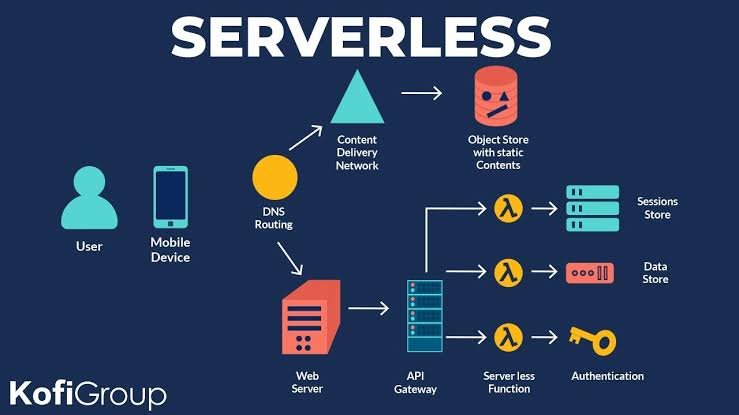
Serverless APIs
Managed API services allow developers to expose application functionality through HTTP endpoints without operating all the underlying API infrastructure themselves.
They can connect a mobile application or website to serverless functions, databases, and authentication systems.
Event-driven messaging
Messaging and event services help different application components communicate. For example, an online store may publish an order event that triggers inventory processing, email notifications, and analytics tasks.
These services allow developers to build applications from independent components that can be maintained and scaled separately.
The exact features and pricing depend on the cloud provider, so developers should compare services according to their requirements.
4. Serverless Computing vs. Traditional Server Management
The main difference between serverless computing and traditional server management is the amount of infrastructure responsibility placed on the development team.
In a traditional setup, an organization may rent virtual machines or operate physical servers. It must then manage operating systems, runtime environments, capacity planning, monitoring, security updates, and scaling strategies.
In a serverless model, the cloud provider handles much of the infrastructure management. Developers deploy code and configure how it interacts with other services.
For example, a business operating a website on virtual machines might need to increase server capacity before a major promotional event. With a suitable serverless architecture, some application components can automatically scale as incoming requests increase.
However, the two approaches are not mutually exclusive. Many applications combine serverless functions with virtual machines, containers, managed databases, and other cloud services.
Serverless computing also does not guarantee lower costs. An application with constant, predictable workloads may run more economically on reserved or continuously utilized infrastructure. A serverless application that generates a large volume of frequent requests can also become expensive if it is poorly optimized.
The choice depends on workload patterns, performance requirements, operational expertise, and pricing.
Traditional infrastructure offers more direct control over the computing environment, while serverless computing reduces many routine infrastructure responsibilities.
For teams that want to move quickly and avoid managing servers, serverless can be an attractive option. For specialized workloads requiring long-running processes or detailed operating system control, other approaches may be more suitable.
5. The Major Benefits of Serverless Computing
Serverless computing has gained attention because it can make application development and operations simpler in several ways.
Reduced infrastructure management
Developers do not need to maintain every server involved in running an application. The provider manages much of the underlying infrastructure, including many routine maintenance tasks.
This can free teams to focus on product development, testing, and improving the user experience.
Automatic scaling
Serverless platforms can often adjust computing capacity according to incoming demand. This is useful for applications with unpredictable traffic or occasional periods of intense activity.
A website that receives a sudden increase in requests may be able to process more work without requiring an administrator to manually provision additional servers.
Usage-based pricing
Many serverless services charge according to factors such as execution time, requests, memory allocation, storage, or data transfer.
This can be economical for applications that run only occasionally because the organization may not need to pay for continuously running application servers.
However, usage-based billing differs across services, and supporting resources may incur separate charges.
Faster development
Serverless services provide ready-made infrastructure for common tasks such as file storage, authentication, messaging, and event processing.
Developers can combine these capabilities rather than building and maintaining every component from scratch.
Easier experimentation
Startups and independent developers can use serverless platforms to test ideas without making a large initial investment in infrastructure.
They can build prototypes, launch small services, and expand their systems as demand grows.
Together, these benefits make serverless computing a useful option for teams that value flexibility, rapid development, and reduced operational overhead.
6. Common Use Cases for Serverless Computing
Serverless computing can support a wide variety of applications, particularly those built around events, APIs, and tasks that do not need to run continuously.
Website and application backends
A mobile application may use serverless functions to handle login requests, retrieve information, validate user input, or process application data.
Managed services can also provide authentication, storage, and database access.
Image and video processing
When a user uploads an image, a serverless function can automatically resize it, compress it, or generate different versions for a website.
Video workflows may use event-driven functions to coordinate processing steps, although computationally intensive tasks may require specialized services.
Online shopping
An e-commerce platform can use serverless functions to validate orders, update inventory, process payment notifications, and send confirmation messages.
Sensitive payment operations must still follow appropriate security and compliance requirements.
Scheduled tasks
Serverless functions can run at specific times to generate reports, clean up temporary files, check service status, or process routine business information.
Data processing
Businesses can use serverless services to transform incoming records, validate data, and prepare information for analytics.
For example, a company might process uploaded sales files automatically and store the cleaned results for reporting.
Chatbots and AI applications
Serverless functions can connect a website to an AI service, validate requests, retrieve relevant data, and return generated responses.
However, long-running AI tasks and high-volume inference workloads may require careful cost and performance planning.
These examples show how serverless computing can support both small features and larger application workflows.
7. Understanding Event-Driven Architecture
Event-driven architecture is one of the most important concepts associated with serverless computing.
In this design, application components respond to events rather than relying entirely on continuous communication between dedicated servers.
An event represents something that has happened, such as a customer placing an order, a file being uploaded, a payment being confirmed, or a sensor reporting a new measurement.
When the event occurs, the relevant service sends a notification or message to the components responsible for processing it.
For example, when an online customer completes a purchase, the application might create an order record and publish an order-created event. Other components can then update inventory, send a confirmation email, and prepare the order for fulfillment.
These activities can be separated instead of being handled inside one large application process.
This approach offers flexibility because individual components can be updated and scaled independently. It can also improve resilience when messaging systems are configured to retain and retry events appropriately.
However, event-driven systems introduce complexity. Events may be delivered more than once, arrive out of order, or fail to process successfully.
Developers must design appropriate retry policies, error handling, monitoring, and idempotency. Idempotency means that processing the same event more than once does not cause unintended duplicate effects.
For example, a repeated payment notification should not result in charging a customer twice.
When these issues are managed carefully, event-driven architecture can make applications more flexible and easier to expand.
8. Serverless Computing and Artificial Intelligence
Artificial intelligence is creating new opportunities for serverless computing.
AI applications often require several supporting tasks beyond the model itself. They may need to authenticate users, prepare data, retrieve documents, record results, process uploaded files, and connect the model to a website or mobile application.
Serverless functions can handle many of these activities.
For example, a customer support application could receive a question through an API, verify the user’s permissions, retrieve relevant information, send the request to an AI model, and return the response.
Another application could analyze documents uploaded by users and automatically extract selected information.
Serverless workflows may also coordinate different AI services, allowing developers to build systems from smaller components.
One advantage is flexibility. Developers can scale supporting functions according to demand rather than operating a dedicated application server for every task.
Nevertheless, AI workloads can have different requirements from ordinary application functions. Model inference may need specialized hardware, substantial memory, or longer execution times. Training large models can require sustained access to powerful computing resources.
In these cases, a managed AI service, dedicated inference endpoint, container, or specialized computing environment may be more appropriate.
The most effective design often combines serverless functions with other cloud services, using each component for the tasks it handles best.
As AI adoption grows, serverless computing is likely to remain a useful building block for developing and connecting intelligent applications.
9. Security in Serverless Environments
Although serverless computing reduces some infrastructure responsibilities, security remains a shared responsibility between the cloud provider and the application team.
The provider typically secures the underlying infrastructure, but developers must protect their code, data, permissions, application interfaces, and service configurations.
One important practice is applying the principle of least privilege. Each function should receive only the permissions it needs to perform its task.
For example, a function that resizes images should not automatically receive permission to access customer payment records.
Sensitive credentials and API keys should be stored in appropriate secret-management services rather than embedded directly in source code.
Developers should also validate incoming requests, protect application endpoints, monitor unusual activity, and keep dependencies updated.
Another concern is excessive permissions between services. A serverless application may contain many small functions, and granting broad access to all of them can increase the impact of a security breach.
Logging and monitoring are equally important. Teams need enough information to identify failures and investigate suspicious behavior without unnecessarily collecting sensitive personal data.
Cloud configuration errors can expose databases or storage systems even when the application code itself is secure.
For this reason, security testing should cover the entire architecture, including functions, APIs, identity policies, storage, messaging, and third-party integrations.
Serverless computing can simplify infrastructure security, but it does not make an application automatically secure.
10. The Challenges and Limitations of Serverless Computing
Despite its advantages, serverless computing introduces several limitations that developers should understand before choosing it for a project.
Cold starts
Some serverless platforms need to initialize an execution environment when a function has not been used recently or when additional capacity is required. This initialization can introduce extra latency, commonly called a cold start.
The impact depends on the platform, runtime, configuration, and workload. Some applications may barely notice it, while others require more consistent response times.
Execution limits
Many function services impose limits on execution duration, memory, storage, or other resources. These limits can make them unsuitable for certain long-running or resource-intensive tasks.
Cost unpredictability
Usage-based pricing can be attractive, but costs may rise unexpectedly when request volume increases or functions are inefficient.
Data transfer, logging, database operations, and other managed services may add to the total bill.
Debugging and monitoring
Applications distributed across many functions and services can be harder to understand than a single application running on one server.
Developers may need distributed tracing, structured logs, and centralized monitoring to identify where a problem occurs.
Vendor dependence
Applications built around provider-specific services may become difficult or expensive to move to another platform.
Using standard interfaces and separating business logic from provider-specific features can help reduce this risk, although it cannot eliminate every migration challenge.
Understanding these limitations allows teams to make better architectural decisions and avoid selecting serverless computing simply because it is popular.
11. Serverless Computing and Cost Management
One of the main reasons businesses consider serverless computing is its pricing model.
Traditional infrastructure often involves paying for allocated computing capacity over time, even when servers are not fully utilized. Serverless services can charge according to actual activity, making them attractive for applications with irregular workloads.
For example, a small service that processes occasional form submissions may not need a dedicated server running continuously.
However, pricing depends on more than the number of function executions. Factors can include execution duration, memory allocation, request volume, storage, database capacity, data transfer, and logging.
A function that repeatedly performs unnecessary calculations or makes multiple expensive database requests can become costly at scale.
Businesses should monitor usage, establish budgets, configure alerts, and review billing reports regularly.
Performance optimization can also reduce costs. Efficient code, appropriate caching, sensible database queries, and well-designed event processing can reduce unnecessary work.
For predictable workloads, it may be worth comparing serverless costs with container-based or virtual-machine alternatives.
The best choice depends on the application’s usage pattern, operational requirements, and the total cost of running and maintaining it.
A useful financial comparison should include not only cloud bills but also the time and expertise required to operate the infrastructure.
12. Serverless Computing vs. Containers
Containers are another popular way to build and deploy modern applications. They package software and its dependencies into portable units that can run consistently across different environments.
Unlike serverless functions, containers can support long-running processes, specialized software stacks, and workloads that need more control over the runtime environment.
Containers are commonly managed through orchestration platforms or managed container services, which may still require configuration and operational oversight.
Serverless computing generally abstracts more of the underlying infrastructure. Developers deploy functions or application components, while the provider handles much of the execution environment management.
The choice depends on the workload.
Serverless functions are often suitable for event processing, short API requests, scheduled tasks, and applications with variable demand.
Containers may be better for long-running services, applications requiring specialized dependencies, streaming workloads, or systems that need greater control over runtime behavior.
Some organizations use both approaches. For example, a containerized application may handle continuous processing, while serverless functions respond to uploads and trigger background tasks.
Neither option is universally superior. Good architecture involves selecting tools according to actual requirements rather than forcing every component into the same deployment model.
13. How to Get Started With Serverless Computing
For developers who want to explore serverless computing, the easiest approach is to begin with a small, practical project.
A simple example is an application that receives a form submission and stores the information in a managed database.
The first step is choosing a cloud provider and learning its function deployment tools. Major cloud platforms offer services for running functions, managing APIs, storing files, and connecting to databases.
Next, developers can write a small function that accepts an input, validates it, and returns a response.
Once the function works locally or in a test environment, it can be deployed and connected to an API endpoint.
The next step is adding monitoring, error handling, and appropriate access permissions. Even a small project should follow basic security practices.
Developers should also test how the application behaves when requests fail, traffic increases, or a dependent service becomes unavailable.
Finally, they should review the platform’s pricing model and monitor resource usage.
Useful learning projects include:
- Building a serverless contact form.
- Creating an image-resizing workflow triggered by file uploads.
- Developing a scheduled report generator.
- Creating a simple API connected to a managed database.
- Building a notification service that responds to application events.
These projects provide practical experience with deployment, permissions, event handling, monitoring, and cloud costs.
Starting small makes it easier to understand the strengths and limitations of serverless computing before using it for a more complex application.
14. The Future of Serverless Computing
Serverless computing is likely to continue evolving as cloud platforms make application development more automated and accessible.
One important direction is the integration of serverless services with AI. Developers may increasingly use managed functions to connect models, process information, coordinate workflows, and respond to intelligent application requests.
Another development is the growing range of managed services. Databases, messaging systems, analytics tools, and application platforms are continuing to reduce the amount of infrastructure that organizations need to operate directly.
Edge computing may also influence serverless architecture. Some applications need to process information closer to users or connected devices to reduce latency and limit data transfer. Managed functions and similar execution models can help support selected edge workloads, although capabilities vary by platform.
Improved development tools may make distributed applications easier to test, deploy, monitor, and troubleshoot.
At the same time, organizations will continue to evaluate cost predictability, portability, security, and operational control.
Serverless computing will not replace every server, container, or traditional application architecture. Some workloads need continuous processing, specialized hardware, or precise control over the operating environment.
Instead, the future is likely to involve a mixture of approaches, with serverless services handling tasks where they provide clear operational or financial benefits.
The main trend is toward allowing developers to focus increasingly on application behavior while cloud platforms manage more of the underlying infrastructure.
Conclusion
Serverless computing has changed the way developers approach application development by reducing the need to manage servers directly. Through managed functions, databases, storage, APIs, and event-driven services, developers can build applications while relying on cloud providers to handle much of the underlying infrastructure.
This approach offers several advantages, including reduced maintenance, automatic scaling, faster development, and usage-based pricing. It can be particularly useful for web application backends, file processing, scheduled tasks, online shopping systems, and applications that connect to AI services.
However, serverless computing also comes with limitations. Execution restrictions, cold starts, debugging complexity, variable costs, and dependence on provider-specific services must all be considered.
Security remains essential, and developers still need to design reliable applications, manage permissions, protect sensitive data, and monitor system behavior.
The decision to adopt serverless computing should therefore depend on the workload rather than the appeal of the technology itself. Some applications benefit greatly from serverless services, while others may work better with containers, virtual machines, or a combination of approaches.
As cloud platforms continue to evolve, serverless computing will remain an important option for building flexible and scalable digital services.
Ultimately, its greatest advantage is not that it eliminates servers. It is that it allows developers to spend less time managing infrastructure and more time solving problems, improving products, and creating useful experiences for the people who depend on their applications.