
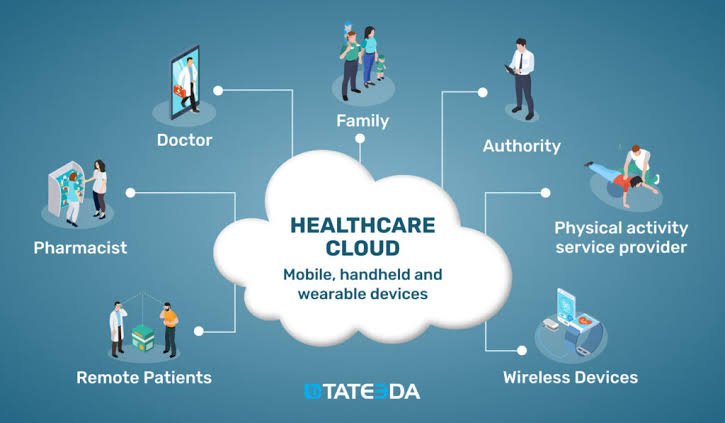
Healthcare is one of the most data-intensive industries in the world. Hospitals, clinics, laboratories, pharmacies, insurance companies, and other healthcare organizations generate and manage enormous amounts of information every day.
Patient records, medical images, laboratory results, prescriptions, billing information, research data, and administrative records all need to be stored, accessed, and protected.
As healthcare becomes increasingly digital, traditional IT infrastructure can struggle to keep up with growing data volumes and changing demands.
This is where cloud computing in healthcare is becoming increasingly important.
Cloud computing allows healthcare organizations to access computing resources, applications, databases, storage, analytics, and other services through cloud infrastructure. Instead of depending entirely on local servers and physical data centers, organizations can use scalable cloud platforms to support digital healthcare services.
Cloud technology is also helping healthcare organizations explore artificial intelligence, telemedicine, data analytics, remote collaboration, and more efficient patient-care workflows.
In this article, we will explore the role of cloud computing in healthcare, its major benefits, applications, security challenges, and the future of cloud-based healthcare technology.
What Is Cloud Computing in Healthcare?
Cloud computing in healthcare refers to the use of internet-based computing services to store, process, manage, and access healthcare information and applications.
Healthcare organizations can use cloud services for a wide range of activities, including:
- Electronic health records
- Medical image storage
- Patient data management
- Telemedicine
- Healthcare analytics
- Artificial intelligence
- Research
- Backup and disaster recovery
- Hospital management
- Remote collaboration
- Patient communication
Rather than keeping all information on servers located inside a hospital or clinic, organizations can use cloud infrastructure operated by specialized technology providers.
Depending on their requirements, healthcare organizations may use public cloud, private cloud, or hybrid cloud environments.
Why Is Cloud Computing Important in Healthcare?
Healthcare organizations are under pressure to provide better services while managing increasing amounts of data.
Patients also expect convenient digital services. They may want to schedule appointments online, communicate with healthcare providers digitally, access test results through an application, or participate in virtual consultations.
At the same time, healthcare providers need reliable access to accurate information.
Cloud computing can help connect these different requirements.
It can provide scalable infrastructure for storing information, supporting applications, and processing data while reducing the need for healthcare organizations to manage every aspect of physical IT infrastructure themselves.
1. Cloud Computing Improves Healthcare Data Storage
One of the most obvious uses of cloud computing is data storage.
Healthcare organizations generate enormous amounts of information, including medical records, diagnostic images, test results, and administrative data.
Traditional storage systems can become expensive and difficult to scale.
Cloud storage provides organizations with flexible storage capacity.
Hospitals can increase storage as their data grows rather than constantly purchasing additional physical hardware.
Cloud platforms can also provide tools for organizing, managing, encrypting, and controlling access to stored information.
However, healthcare organizations need carefully designed data-management policies to ensure that sensitive information is stored and accessed appropriately.
2. Easier Access to Patient Information
Healthcare professionals often need access to patient information at different locations.
A doctor may need information while working in a hospital. Another specialist may need access from a different facility.
Cloud-based healthcare systems can make authorized information accessible across multiple locations.
This can support collaboration between healthcare professionals.
For example, a specialist in another location could potentially review relevant medical information without requiring physical copies of records to be transported.
Access should always be controlled using appropriate authentication and authorization mechanisms.
3. Supporting Electronic Health Records
Electronic health records, or EHRs, are central to modern healthcare.
They allow healthcare organizations to manage patient information digitally instead of relying primarily on paper records.
Cloud computing can provide infrastructure for EHR applications and related services.
Cloud-based systems can help healthcare providers access information across departments and locations while supporting centralized management.
The specific capabilities of an EHR system depend on the provider and healthcare organization, but cloud infrastructure can provide scalability and accessibility.
4. Cloud Computing Enables Telemedicine
Telemedicine has become an important part of modern healthcare.
Patients can communicate with healthcare professionals through video consultations, messaging, and other digital services.
Cloud computing can provide infrastructure for these services.
A telemedicine platform may need to handle:
- Video communication
- Patient records
- Appointment scheduling
- Digital prescriptions
- Secure messaging
- Medical documents
- Billing information
Cloud infrastructure can help telemedicine services scale as the number of users changes.
This can be especially useful for healthcare organizations serving large or geographically distributed patient populations.
5. Better Healthcare Data Analytics
Healthcare organizations generate huge amounts of data, but collecting information is only the beginning.
The real value comes from analyzing it.
Cloud computing provides scalable resources for processing large healthcare datasets.
Healthcare organizations can use analytics to examine:
- Patient outcomes
- Hospital operations
- Resource utilization
- Treatment patterns
- Appointment demand
- Population health trends
- Financial performance
Data analytics can help healthcare leaders make better-informed operational decisions.
However, healthcare analytics must be performed responsibly, with appropriate privacy protections and governance.
6. Artificial Intelligence in Healthcare
Artificial intelligence is one of the most important technologies benefiting from cloud computing.
AI applications can require significant computing power and large datasets.
Cloud platforms can provide the infrastructure needed to train and operate machine learning models.
Healthcare organizations can explore AI applications in areas such as:
- Medical image analysis
- Clinical decision support
- Patient risk prediction
- Administrative automation
- Drug research
- Documentation assistance
- Healthcare chatbots
- Predictive analytics
For example, AI systems can be trained to identify patterns in medical images or analyze large datasets for research purposes.
AI should be used carefully in healthcare. Clinical decisions require appropriate validation, professional oversight, and compliance with applicable regulations.
7. Improved Collaboration Between Healthcare Professionals
Healthcare is highly collaborative.
Doctors, nurses, specialists, laboratory professionals, pharmacists, administrators, and researchers may all need to work with related information.
Cloud-based platforms can make collaboration easier by providing centralized access to authorized resources.
Teams can share documents, reports, research information, and other digital resources without relying entirely on physical files.
This can be particularly valuable for organizations operating across multiple locations.
8. Cloud Computing Supports Medical Research
Medical research generates enormous datasets.
Researchers may work with clinical information, genomic data, medical images, scientific studies, and experimental results.
Cloud computing can provide scalable computing resources for research projects.
Instead of purchasing expensive infrastructure for every research project, researchers can potentially access cloud resources when needed.
This can support activities such as:
- Data analysis
- Genomic research
- Drug discovery
- Medical simulations
- Machine learning
- Statistical analysis
Cloud-based research infrastructure can also make collaboration between geographically separated research teams easier.
9. Disaster Recovery and Data Backup
Healthcare organizations cannot afford to lose important information.
Hardware failures, natural disasters, cyber incidents, and other unexpected events can disrupt IT systems.
Cloud-based backup and disaster recovery solutions can provide additional protection for critical data.
Healthcare organizations can maintain copies of important information in separate infrastructure and establish procedures for restoring systems after an incident.
A comprehensive disaster recovery strategy should include regular backups, appropriate retention policies, access controls, recovery testing, and clearly defined recovery objectives.
Cloud technology can support disaster recovery, but it does not eliminate the need for planning.
10. Healthcare Cloud Security
Security is one of the most important considerations when adopting cloud computing in healthcare.
Medical information is highly sensitive and can be attractive to cybercriminals.
Healthcare organizations therefore need strong security measures.
These can include:
- Encryption
- Multi-factor authentication
- Identity and access management
- Network security
- Activity monitoring
- Data-loss prevention
- Vulnerability management
- Regular security assessments
- Employee security training
Organizations should also carefully manage permissions.
Employees should only have access to information required for their responsibilities.
Cloud providers can secure their infrastructure, but healthcare organizations remain responsible for many aspects of how their cloud services, applications, users, and data are configured.
11. Compliance and Privacy
Healthcare is highly regulated in many countries.
In the United States, organizations handling protected health information may need to comply with requirements such as HIPAA, depending on their role and activities.
Cloud adoption therefore requires careful evaluation of providers, contracts, data handling, access controls, audit capabilities, and security practices.
Healthcare organizations should understand exactly where information is stored and how it is processed.
Compliance should be treated as an ongoing process rather than a one-time cloud migration checklist.
12. Reduced IT Infrastructure Burden
Operating a healthcare facility requires significant IT resources.
Organizations may need servers, storage, networking equipment, backup systems, software, and technical staff.
Cloud computing can reduce some of the infrastructure that organizations need to operate directly.
Instead of purchasing hardware whenever additional capacity is needed, organizations can use cloud services.
This can allow internal IT teams to focus more on applications, security, user support, and strategic projects.
Cloud computing does not eliminate IT work, but it can change how technical resources are allocated.
13. Better Patient Experiences
Patients increasingly expect convenient digital healthcare services.
Cloud-based applications can support features such as:
- Online appointment scheduling
- Patient portals
- Digital communications
- Telehealth
- Access to test results
- Prescription management
- Appointment reminders
These services can make healthcare interactions more convenient.
However, healthcare providers must balance convenience with security and accessibility so that digital services do not exclude patients who have limited technology access.
14. Supporting Connected Healthcare Devices
The Internet of Things is becoming increasingly relevant to healthcare.
Wearable devices and connected medical equipment can generate continuous streams of information.
Cloud infrastructure can provide a place to store and analyze this information.
For example, a healthcare organization could collect data from connected monitoring devices and analyze trends over time.
When combined with AI and analytics, connected healthcare technologies could support more proactive approaches to monitoring and patient care.
Any such system must be designed with privacy, security, accuracy, and clinical oversight in mind.
Public Cloud vs. Private Cloud vs. Hybrid Cloud in Healthcare
Healthcare organizations can choose from several cloud deployment models.
Public Cloud
Public cloud services are operated by third-party providers and can provide scalable infrastructure and access to advanced services.
Private Cloud
Private cloud environments provide dedicated infrastructure for a specific organization and may offer greater control over certain workloads.
Hybrid Cloud
Hybrid cloud combines private infrastructure with public cloud services.
This approach can allow healthcare organizations to keep certain sensitive workloads in controlled environments while using public cloud resources for applications that benefit from scalability.
Many organizations use a combination of approaches rather than relying on a single model.
Challenges of Cloud Computing in Healthcare
Cloud technology provides many benefits, but healthcare organizations must also manage significant challenges.
Data Privacy
Sensitive patient information must be protected throughout its lifecycle.
Cybersecurity
Cloud systems can become targets for ransomware, phishing, credential theft, and other attacks.
Compliance
Organizations must ensure that their cloud environments comply with applicable healthcare and privacy regulations.
Integration
Cloud applications need to communicate with existing healthcare systems, which can be technically challenging.
Cost Management
Cloud services can become expensive if organizations do not monitor resource usage.
Vendor Lock-In
Moving large healthcare datasets and applications between cloud providers can be difficult.
The Future of Cloud Computing in Healthcare
The future of cloud computing in healthcare will likely involve deeper integration with artificial intelligence, edge computing, connected medical devices, advanced analytics, and automation.
Healthcare organizations may increasingly use AI-powered cloud platforms to analyze information and support clinical and administrative workflows.
Edge computing could also become important for medical devices and applications that require extremely fast responses.
At the same time, security and privacy will become even more important as healthcare organizations process larger amounts of sensitive digital information.
The healthcare cloud of the future will therefore need to be not only scalable but also secure, reliable, interoperable, and carefully governed.
How Healthcare Organizations Can Prepare
Healthcare organizations considering cloud adoption should begin with a clear strategy.
They should identify which workloads are suitable for cloud environments and evaluate security, privacy, compliance, integration, cost, and performance requirements.
Organizations should also:
- Establish strong identity and access controls
- Encrypt sensitive information
- Train employees on cybersecurity
- Create backup and recovery plans
- Monitor cloud activity
- Evaluate vendors carefully
- Test disaster recovery procedures
- Develop clear data-governance policies
Cloud migration should be approached as a long-term transformation rather than a simple technology upgrade.
Final Thoughts
Cloud computing is playing an increasingly important role in healthcare.
It can help healthcare organizations manage growing amounts of data, support telemedicine, improve collaboration, enable advanced analytics, provide scalable infrastructure, and create a foundation for artificial intelligence.
Cloud technology can also support disaster recovery, digital patient services, connected medical devices, and medical research.
However, healthcare organizations must approach cloud adoption carefully. Patient privacy, cybersecurity, regulatory compliance, reliability, and data governance are essential.
The future of healthcare will likely be increasingly digital, and cloud computing will provide much of the infrastructure behind that transformation.
When implemented responsibly, cloud computing can help healthcare organizations become more flexible, data-driven, and connected while supporting better digital experiences for both healthcare professionals and patients.